



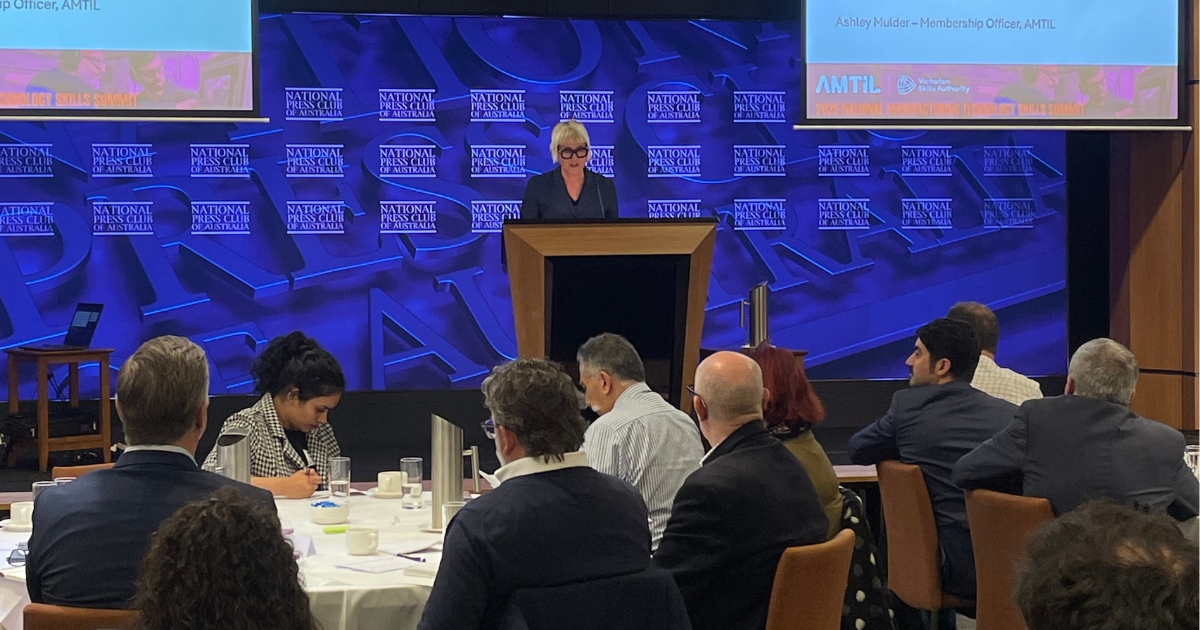
National summit brings together 40 organisations to tackle Australia’s CNC skills crisis and lay the groundwork for a coordinated, future-ready manufacturing workforce.
Leading voices in Australia’s manufacturing technology industry convened in Canberra on August 21 for the National Manufacturing Technology Skills Summit. The event, led by AMTIL and facilitated by the Victorian Skills Authority, focused on crafting an actionable plan to address the critical and widening shortage of qualified CNC (Computer Numerical Control) operators across the country.
While demand outweighs supply for many skillsets required by the manufacturing industry, the lack of CNC professionals stands out as a particularly urgent issue. AMTIL estimates that the shortage currently sees 1,000 roles unfilled, a figure projected to exceed 3,000 within two years without deliberate intervention.
The reasons behind the shortage are multifaceted. Training to competency takes time, with a Certificate IV typically requiring several years of vocational education, followed by extensive on-the-job training. Given the high cost of CNC machinery and materials, operators must be adequately skilled to avoid costly errors and ensure consistent quality. Yet, despite the technical sophistication and stability of the role, CNC operation remains under-recognised as a stepping-stone in a career path.
“A lot of Australians still associate manufacturing with the historical closure of large manufacturing plants, or with outdated images of dirty, dangerous assembly lines,” said a summit participant. “In reality, today’s manufacturing is predominantly clean, safe, and highly technical—one of the most advanced industries in the country.”
The summit, hosted at the National Press Club, drew representatives from 40 organisations spanning industry, education, government, and associations. Through structured workshops, participants mapped out the causes of the shortage and explored potential initiatives to close the gap.
The impact of the shortage is already being felt. While specific examples vary, the constraint on skilled CNC operators limits manufacturers’ ability to scale, innovate, and respond to national needs—particularly in the wake of COVID-era supply chain disruptions and growing calls for sovereign capability.
“Addressing this shortage isn’t just about filling jobs, it’s about unlocking Australia’s potential to lead in advanced manufacturing and emerging technologies,” said AMTIL CEO Lorraine Maxwell. “We have the talent and the tools. Now we need the workforce.”
With action items identified and strong interest from participants to support next steps, the summit marks a turning point. AMTIL, as Australia’s peak industry body for precision manufacturing, is proud to lead the charge.
The forthcoming Summit Report will capture key findings and recommendations, forming the foundation of a national action plan. Stay tuned for more information.