



A recent announcement from two world-leading technology companies has potential to disrupt manufacturing processes globally. The term is “physical AI”, and it could reshape how Australian manufacturers design, validate and build.
- Newly announced technology greatly expands capacity of AI
- Replicates real world physics to truncate lead time and simulate stress testing of products
- Rolling out to select partners imminently, with plans for broad availability this year
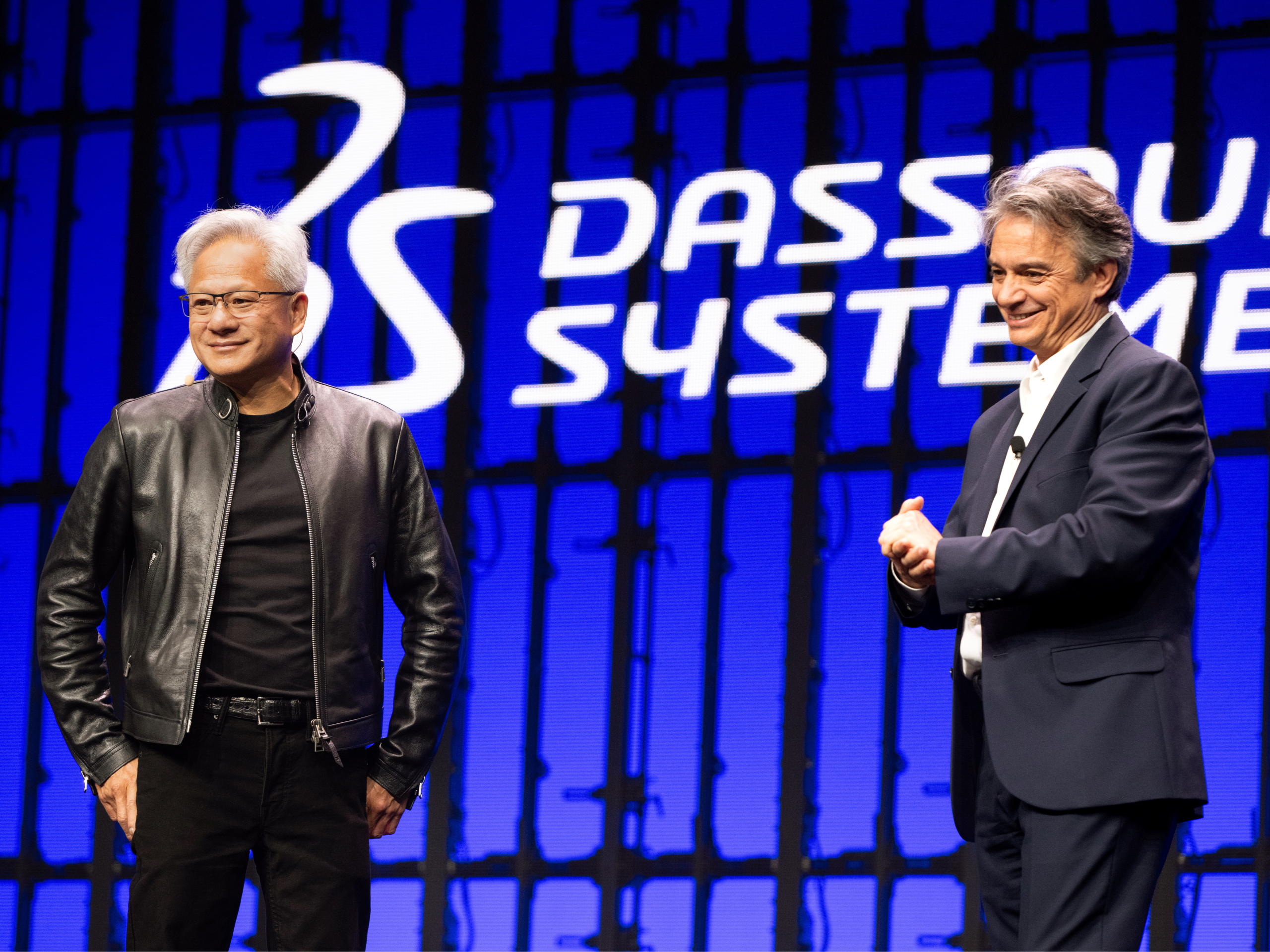
At 3DEXPERIENCE World in Houston, a joint announcement from NVIDIA CEO Jensen Huang and Dassault Systèmes CEO Pascal Daloz put “physical AI” and production‑grade virtual twins at the centre one of the largest engineering gatherings of the year. The message delivered to nearly ten thousand attendees was bold: a new class of industrial AI, grounded in physics rather than just language, could compress the distance between concept and reality in dramatic fashion.
Whether or not this partnership ends up defining the next decade of manufacturing software, the idea of physical AI matters. It signals a shift that could reshape design, simulation, testing and factory optimisation for manufacturers of all sizes, including in Australia’s precision sector.
“AI is just an engine — you are the driver.”
— Manish Kumar CEO and Vice President R&D, SOLIDWORKS (a subsidiary of Dassault Systèmes
The through‑line across the event was simple: physics still rules. Engineers set intent. AI multiplies what they can do.
What ‘physical AI’ actually is
The term refers to AI models built not just on text or images, but on science‑validated engineering knowledge. Rather than guessing from patterns, these models are constrained by the laws of physics: loads, materials, tolerances, compliance requirements and realistic boundary conditions.
This distinction matters because it moves AI from the realm of content generation into the realm of engineering-grade decision support.
A related concept is the “virtual twin”. While a digital twin mirrors the state of an object, a virtual twin models behaviour, including how something bends, breaks, flows or fails. It lets engineers explore scenarios in software with fidelity that historically required physical prototypes, long test cycles or expensive retooling.
Together, physical AI and virtual twins promise to shift more engineering effort into the digital domain, with higher confidence and lower cost.
A glimpse of what changes: the live demo
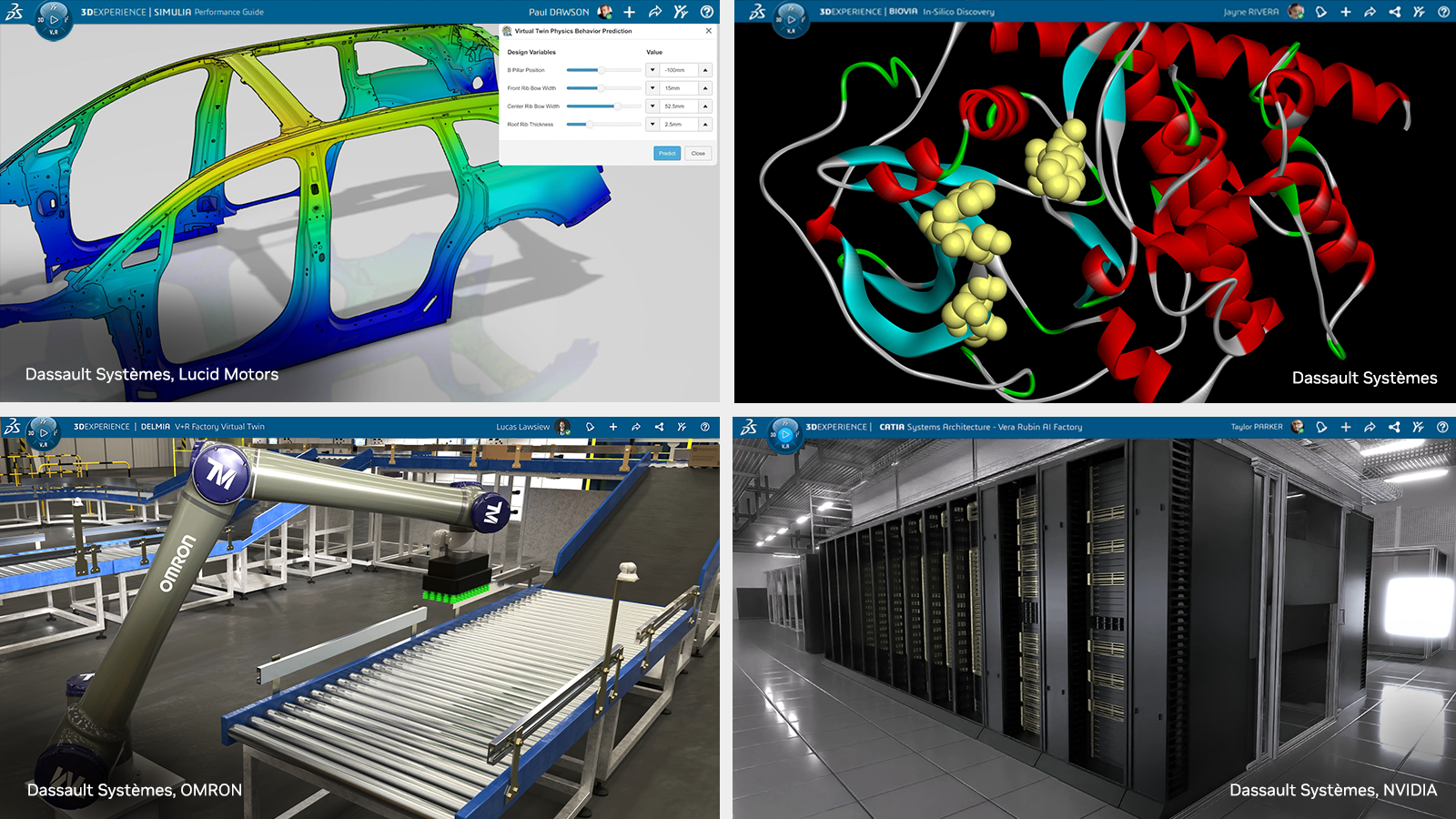
One of the clearest demonstrations involved designing a structural support for a cylindrical water tower. An engineer provided the requirements through a simple text prompt, much like chatting with an assistant. The system interpreted the instructions, generated a full 3D model within minutes, and immediately began stress‑testing the design.
The workflow operated across three layers:
1. Interpretation layer
The system understood intent from text, sketches or rough schematics, placing it in the correct engineering context.
2. Creation layer
Usable 3D parts and assemblies were generated automatically, with no manual modelling required.
3. Physics layer
The engine ran thousands of virtual stress tests, proposed suitable materials, flagged weak points and suggested improvements. It blended learned patterns with validated physics models.
This wasn’t a canned animation. It responded dynamically to new constraints, updated geometry in real time and produced engineering‑grade outputs that would traditionally require multiple specialists.
The takeaway? It lowered the cost (both time and mental load) of exploring complex ideas.
How soon could this land? And how might it be priced?
Public comments from Dassault Systèmes suggest the underlying infrastructure, the so‑called AI Factory, is expected to come online this year for internal workloads, with customer‑facing integrations following soon after. Companion tools demonstrated on stage were also positioned as near‑term capabilities, not speculative prototypes.
Pricing signals hint at modular, credit‑based usage, where companion features consume “labour‑unit” credits rather than flat licences. While not confirmed, this aligns with how agent‑based automation typically scales.
Regardless of the exact timing, the broader point is clear: if one major ecosystem moves quickly, others will follow. Expect 2026–27 to bring competitive offerings from multiple vendors.
Why decision makers should care
1. Faster design cycles
Turning a requirement into a viable model in minutes dramatically reduces the cost of early‑stage exploration.
2. Fewer physical prototypes
Running thousands of digital tests before touching a machine means fewer surprises later.
3. Better compliance-by-design
Regulated industries (such as defence, aerospace, medical devices) stand to benefit from design tools that embed compliance logic from the outset rather than bolting it on later.
4. Reduced cost of iteration
The system’s rapid feedback loop encourages more ambitious design exploration, because iteration is cheap rather than painful.
5. Risk to (and reinforcement of) engineering jobs
Speakers were unequivocal: the goal is to augment, not replace, engineers. Humans provide purpose and judgement; AI expands the design and simulation search space and handles repetitive tasks.
But the market reality remains: some businesses will be tempted to treat AI’s efficiency gains as justification for reducing headcount. The difference between a good and bad outcome lies in leadership intent, and in the KPIs chosen to measure success.
A practical KPI set for value creation over headcount cuts
- First‑pass yield
- Changeover time
- Hours‑to‑sign‑off for new designs
- Hours per design variant
- Scrap and rework rates
These metrics turn efficiency into competitive advantage, not job losses.
The supply chain impact: an opening for middle powers
If physical AI works as intended, the cost of engineering excellence drops. You no longer need to be a global superpower with massive R&D centres to design complex systems quickly.
Australia, as a “middle power,” could benefit in several ways:
- Faster virtual prototyping means more development can happen domestically.
- Companies without deep software engineering teams can still compete.
- Smaller firms can automate high‑mix tasks that were previously out of reach.
- Sovereign capability improves when critical design and validation cycles stay onshore.
As NVIDIA CEO Jensen Huang put it in a press session: “If I were Australia, I would jump onto AI as quickly as possible.”
Which Australian industries may feel it first?
Defence and aerospace
Compliance‑aware design and simulation-heavy workflows make these sectors natural early adopters.
Medtech
Devices that must meet stringent regulatory pathways benefit from physics‑informed design exploration.
Precision machining and additive manufacturing
High‑mix, low‑volume shops stand to gain from virtual commissioning and implicit‑learning robotics.
Mining equipment and energy systems
Simulation-first development may reduce barriers to onshoring specialised components.
Each of these sectors sits at a crossroads where digital capability will increasingly determine competitiveness.
What to watch next
Model fidelity
Early adopters will scrutinise how reliably the system’s physics models match real-world outcomes.
Vendor competition
Other CAD/CAE/PLM providers will presumably accelerate their roadmaps. Expect rapid releases and strategic partnerships across the sector.
Sovereign cloud and IP governance
Questions of data residency, IP rights for AI‑generated artefacts and model provenance will rise quickly. Businesses with sensitive designs should track this closely.
Bottom line
A physics‑aware AI layer is entering mainstream engineering software. The hype cycle will run, but the underlying shift is real: design, testing and validation are becoming dramatically faster, more accessible and more simulation‑first.
For Australian manufacturers, the opportunity is clear: pilot the tech early on one well‑chosen product or cell, measure it against meaningful KPIs, and build internal capability before the rest of the market catches up.
If the promise of physical AI holds, the next decade of manufacturing will be shaped less by who has the biggest facilities, and more by who can design, validate and iterate the fastest.