



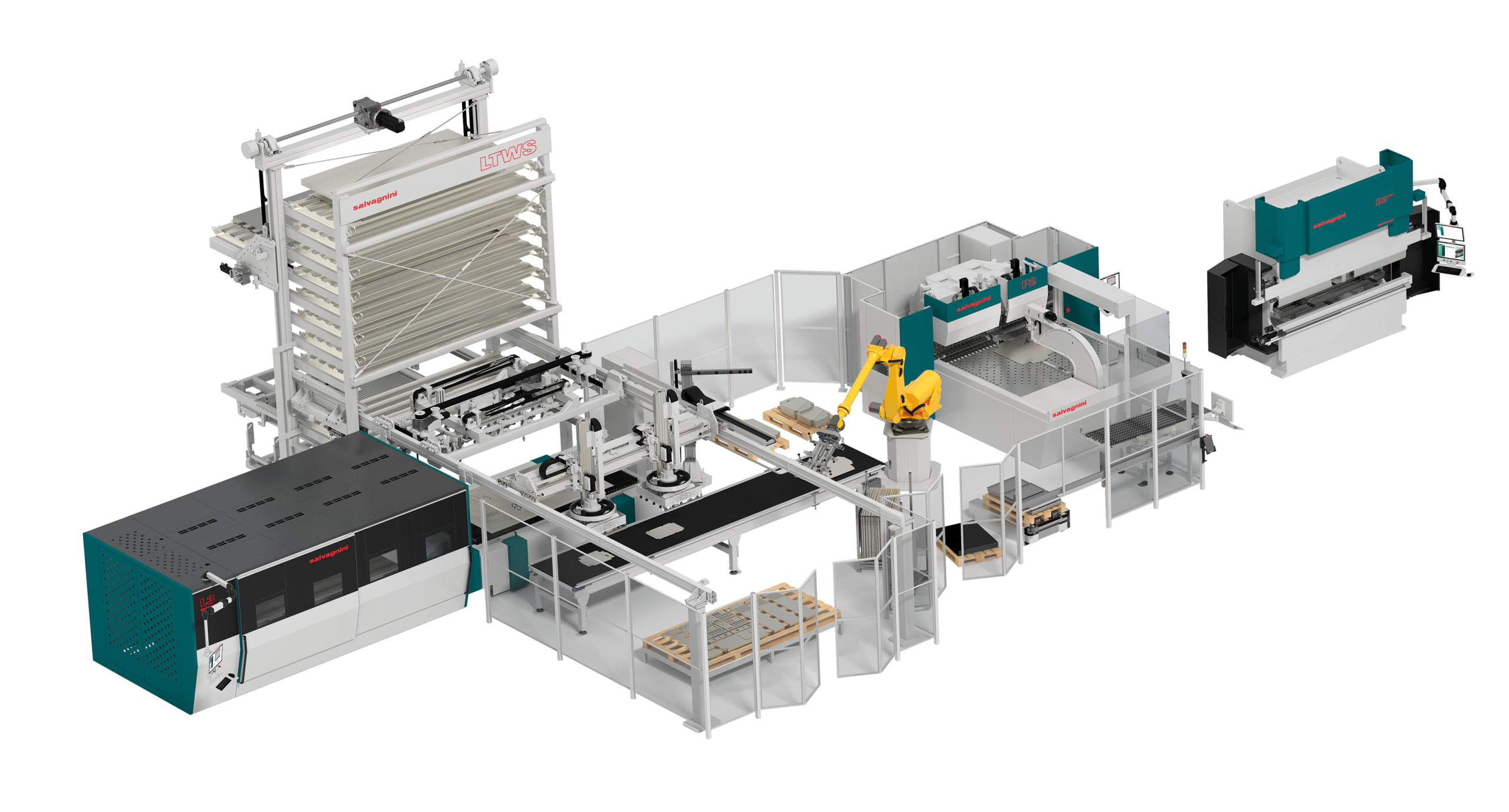
Salvagnini’s Flexible Smart Job Shop (FSJ) integrates three different stand-alone systems that work together to handle converging production jobs
Flexible Smart Job Shop (FSJ) is an advanced, connected, and fully integrated flexible production system that enables the automatic production of various parts without operator intervention or machine downtime for retooling. The systems that make up the FSJ can operate independently or collaboratively, adapting to diverse production needs, from creating small batches to producing complex kits. The integration of intermediate storage and upstream and downstream workstations provides exceptional flexibility, making it ideal for optimising production flows and supporting just-in-time production, thus reducing idle times and waste. The RVS artificial vision system streamlines the management of robotic assistance, accelerates the intermediate recognition and handling steps, and maximises the value of the finished part. In fact, due to enhanced connectivity and the latest technological solutions, FSJ leverages the capabilities of artificial intelligence and robotics to optimise production processes. It also addresses the increasingly stringent environmental and economic sustainability requirements, contributing to an efficient and responsible production model.
The FSJ consists of the new L3.G4 fibre laser, which is fully automated; the P-Robot, which combines a P2-2120.G4 panel bender with a 6-axis robot; and the B3 press brake.
High-performance and versatile fibre laser. L3.G4 boasts automated configuration, neural-network-based artificial vision, and advanced material handling. The system introduces a high-accessibility gantry architecture, combining rigidity, precision, and a 15% increase in performance on medium-to-thin thicknesses. The ACUT option enables cost-effective cutting with compressed air, while NVS and SVS artificial vision systems enhance beam centering accuracy and the efficient reuse of sheet metal leftovers. The STREAMLASER software with the OPTI nesting algorithm and SAFE GRID feature further reduces costs and optimizes material usage. LTWS store-tower supports unmanned loading and unloading with extremely short cycle times of up to 50 seconds. The MCU automatic sorting device is used to easily stack parts of different shapes, sizes, and weights, improving productivity by reducing operator intervention. NEXUS software optimizes sorting flexibility, accommodating dynamic production scenarios and batch management effortlessly.
P-Robot. 100% flexible production strategy. P-Robot is the Salvagnini application that combines a P2-2120.G4 panel bender with a 6-axis robot to maximise flexibility in kit, batch, or single-part production. Integrated with the innovative RVS (Robot Vision System), P-Robot autonomously identifies and positions parts, and loads them without operator intervention and centring. P-Robot’s flexible operating modes—robot-to-robot (R2R), robot-to-human (R2H), and human-to-robot (H2R)—adapt to production needs seamlessly without retooling. Thanks to adaptive technologies, the P2.G4’s universal bending tools and automatic ABA blankholder allow continuous production without downtime, ensuring zero-waste output. The panel bending program, created with STREAMBEND, works seamlessly on both P-Robot and standard panel benders without modification. On board the machine, the MOVE software autonomously manages intermediate robot movements, significantly reducing operator intervention, making offline robot programming pointless.
The press brake combines productivity and flexibility. The B3 press brake integrates productivity and flexibility, making it ideal for dynamic manufacturing environments. Equipped with ATA and ATA.L devices, the B3 automatically adjusts the length of the upper and lower bending tools, saving time and enhancing production efficiency. Technical innovations such as Direct Drive motors and KERS energy recovery ensure fast, efficient, and environmentally friendly operation without sacrificing productivity. Adaptive technologies like MAC3.0, S-Crowning, TFC2.0, and AMS laser angle measurement enhance accuracy, compensate for material variations, and assure consistent bending results. The intuitive STREAMFORMER software, ideal for offline programming, further increases overall system efficiency and productivity.