



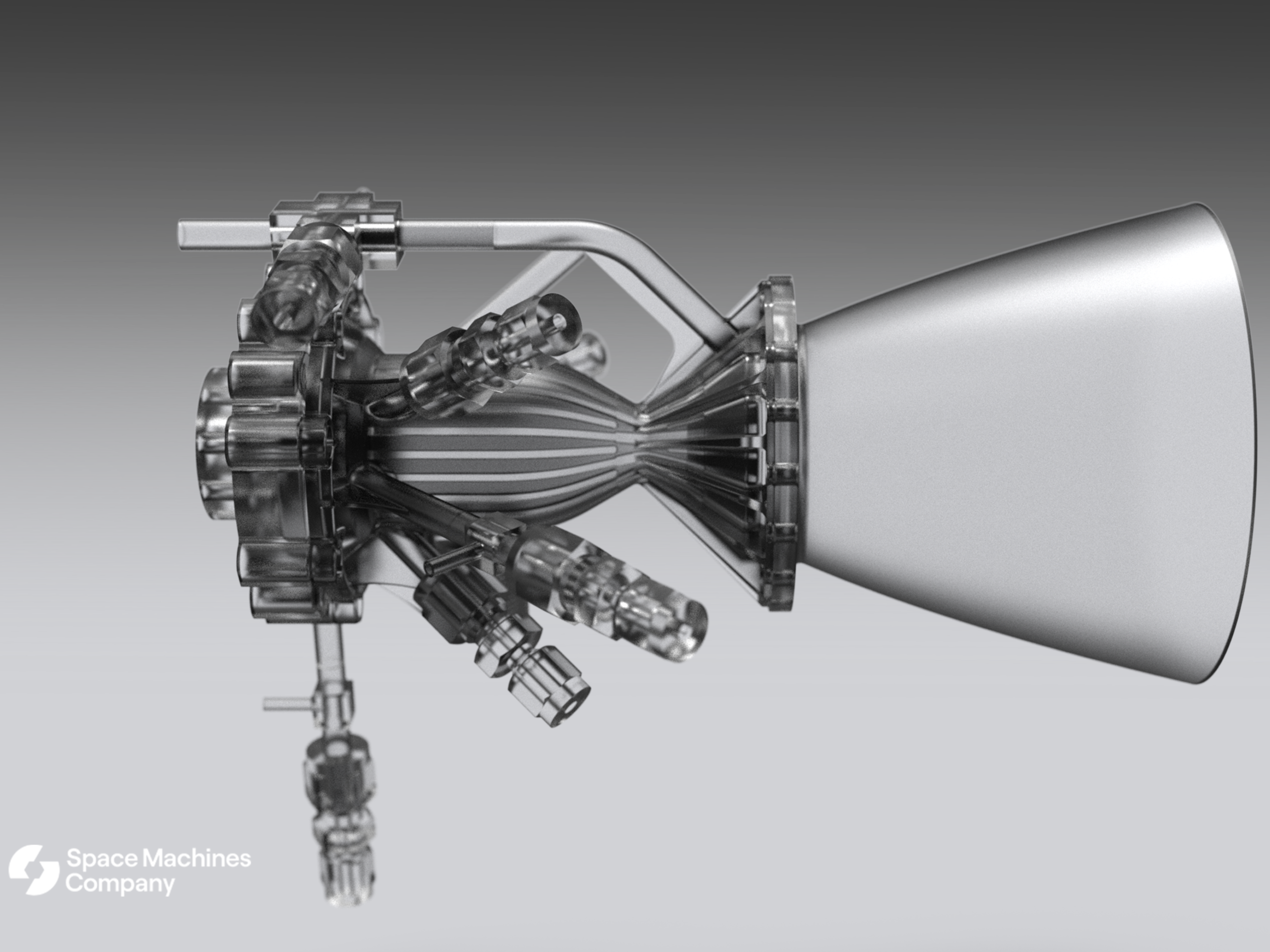
Space Machines Company’s Scintilla propulsion engine is a rarity in the global satellite market, where most companies rely on external suppliers.
Sydney-based Space Machines Company has completed work on Australia’s first locally built engine for satellites, without relying on overseas suppliers.
The Scintilla propulsion engine will be a major component of the company’s Optimus Viper rapid response vehicle, designed for rapid orbital manoeuvring and space domain awareness missions.
SMC vice president of engineering and mission operations Ian Partis said the company had set out to vertically integrate the propulsion system for its Optimus Viper, rather than outsourcing the propulsion system to a third party.
“The better the propulsion system and the more delta-v available, the greater range of orbits we can access and the faster we can get there,” he says.
“This is so fundamental to our mission that the satellite is essentially a propulsion system with a payload on top.”
SMC co-founder and chief executive Rajat Kulshrestha said the company had progressed faster on the engine than even their most optimistic predictions.
“The engine has reached steady-state conditions and demonstrated the ability to run for extended periods – a critical requirement for our satellite operations,” he said.
“We can now run this engine for minutes, limited only by total propellant supply from our tanks.”
The engine has achieved burn durations of 65 seconds, with a demonstrated ability to burn for longer over 1,200 seconds of total testing time, including 40 restarts and counting.
Tested across varying conditions, the engine delivered 50 Newtons of thrust while maintaining 92% efficiency – with a clear pathway to near-100% efficiency in future iterations.
SMC says the propulsion system’s design allows for significant performance scaling, including the ability to increase thrust from the current 50 Newtons to 100-500 Newtons through relatively minor modifications.
Kulshrestha says the team had made a series of discoveries during the construction and development process, while ensuring continuous learning capabilities through co-located testing and manufacturing facilities.
“When the team identified an issue during testing, they were able to diagnose it within 10 minutes and implement solutions immediately. This kind of responsiveness is impossible when working with external suppliers,” he says.
Having now completed its critical design review phases, SMC is now combining the engine with flight-grade valves and propellant management systems into what it says will be a complete propulsion system.
“After separately testing the Scintilla thruster and flight-ready components like valves, regulators, electronics, and sensors to ensure they’re space-ready, these parts are assembled together,” a company spokesperson told AMTIL.
“The integrated propulsion subsystem then undergoes comprehensive testing as a single unit to verify all components work harmoniously.”
“This critical step validates system performance before the propulsion subsystem is integrated into the Viper spacecraft platform for final stack testing, ensuring mission reliability.”