



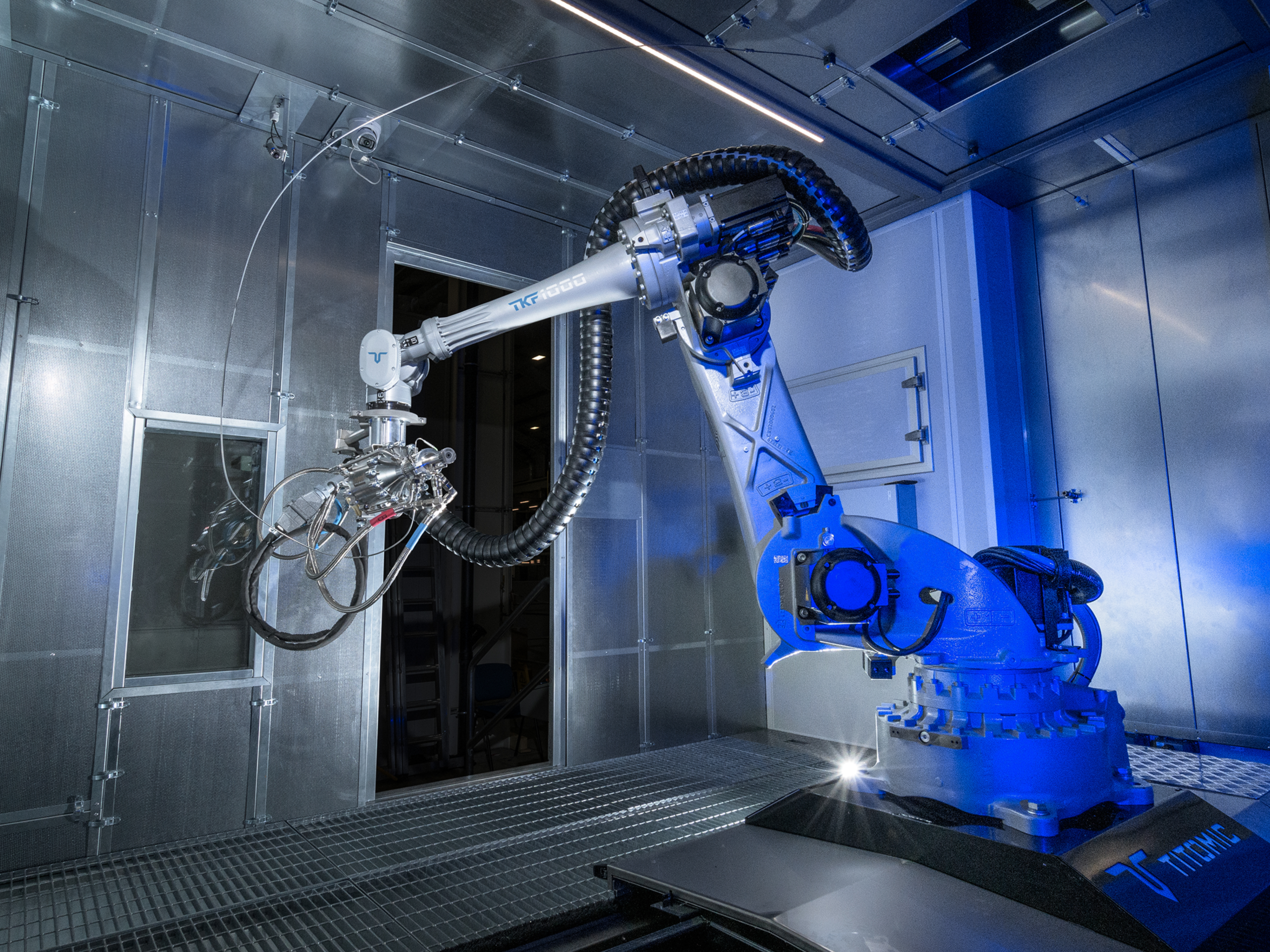
Today Australia holds a world-leading position in cold spray additive manufacturing (CSAM) – thanks to years of work in making the technology more widely accessible
**This story originally appeared in the February 2026 edition of AMT Magazine**
Developed by accident overseas, adopted in Australia after investments from a food packaging printer and today used to restore fast jets – cold spray additive manufacturing (CSAM) technology is, one Melbourne specialist insists, “just another tool” in the advanced manufacturing toolbox.
What Rosebank Engineering Senior Manager, Engineering and Projects Jarrod Watts means is that CSAM technology should be considered the same as any other specialist manufacturing process – like semi-automated shot peening or precision multi-axis CNC machining – a highly technical innovation, but one which is accessible to a wide pool of manufacturers.
“There’s no doubt Australia is seen as a world leader in this innovative technology,” he says.
“We’re no longer just sustaining Australian assets – we’re part of a global supply chain, and technologies like this help us compete and win on a global stage,” he says.
“The momentum is certainly building, and the customer base is expanding. People are recognising the opportunity of cold spray… it’s just about building the confidence, building the trust and expanding the knowledge-base across multiple domains – that’s where the productivity benefits will come.”
Much of the reason for this initial success is down to the hard work of Australia’s national science agency CSIRO and the courage, passion and resilience of the people that work there.
So says Saden Zahiri, who is a principal research scientist for cold spray platform technology at CSIRO and an adjunct professor at Swinburne University of Technology.
As he explains, cold spray technology was first developed in the early 1980s by Anatolii Papyrin, when he found the bits of metal he was using to simulate high velocity particles hitting satellites were instead becoming welded to the walls of the wind tunnel where his experiments took place.
“The cold spray system accelerates particles to well above supersonic speeds (typically >1500 m/s) to create a unique solid-state bonding under impact, similar to explosive welding,” Zahiri says.
The main benefit, he says, is that the metal particles are never melted into place – meaning heat does not impact either the material being added, or its destination.
“This overcame a major challenge in joining dissimilar metals/materials and was a dream come true for many industrial applications, to coat dissimilar metals such as copper and aluminium or titanium and aluminium, cost effectively and at scale.”
Today, Watts says that Rosebank Engineering uses cold spray technology in the same way, for new wear-resistant coatings and restoration of specific materials.
The company has long been providing aircraft sustainment services to both the Royal Australian Air Force (RAAF) and Royal Malaysian Air Force (RMAF), including supporting the RMAF to establish in-country deep-level maintenance capability during the COVID-19 pandemic.
“The first aircraft entered its 12-year maintenance activity in 2020, and very quickly the cost and lead-time improvements that could be realised through Cold Spray restorations were an avenue the RMAF were keen to explore.”
Watts explains that using cold spray technologies enables Rosebank to design the repair solution without being constrained by the substrate material, enabling restorations which exceed prior material performance, and overcome identified modes of degradation.
“We’ve spot-repaired electroplated nickel coatings on F/A-18 components in the past – so rather than stripping the component and re-electroplating it, we can locally repair the damage with cold spray nickel.
“That was a much faster, more-cost effective restoration. In a similar manner, Cold Spray enables us to move away from toxic plating chemicals such as chrome – it’s a fantastic alternative.”
The company’s work and collaboration with RMAF and the US Navy led to Rosebank designing a series of non-structural cold spray repairs an F/A-18 airframe and, in May 2025, the company applied the first cold spray repairs to an F/A-18 jet on site at RMAF Butterworth.
“That was a world first activity, and one which drew a lot of interest, but with it came almost with a sense of admiration that we’d been able to work so collaboratively to achieve the outcome. As a follow up to that activity, our team has just returned from Malaysia, completing a number of repairs on a different tail, where we’re recovering damage on both aluminium and titanium substrates,” Watts says.
“By recovering worn titanium in a damaged area, we’re effectively building a sacrificial layer that can continue to wear in the future without the damage progressing into the primary structure… it’s a really simple and cost-effective process.”
Watts says there’s now growing interest in expanding the application across different aircraft types.
“I think the key to its broader uptake is that the technology is answering the need of a customer, it’s solving a problem in a more cost-effective and efficient way, rather than the technology trying to drive the solution,” he says.
“The customer is coming to us saying, ‘here’s our problem, how can you help us Rosebank? And that’s where, if it makes sense, we’re using cold spray.”
“The technology has matured to the point where people understand its application now. It’s certainly not for every repair, but in the right application, with the right materials, and under the right loading conditions, it’s excellent,” he says.
Watts adds that Australian cold spray technology is competitive on the global stage, and that there are numerous future opportunities for success.
“We’re no longer just supporting an Australian fleet – we’re part of a global supply chain, so we’re leveraging our local success to a global customer,” he says.
To look at how Australia got to that position, we need to look back to 2003, when through the efforts of Mahnaz Jahedi and Stefan Gulizia, the first robotic cold spray additive manufacturing facility in the Southern Hemisphere was established in Melbourne through CSIRO.
Saden Zahiri says this was achieved with the support of Kirk Group – which at the time was the leading company in Australia for gravure printing rollers that produced colourful product packaging.
“Mahnaz had to bring a commercial project to be able to get the funding for the cold spray machine before even having the machine at CSIRO,” he remembers.
“She persuaded Kirk Group to invest sufficient funding in the technology – and CSIRO supported Mahnaz to purchase the machine after Kirk Group’s support.”
Once established, it didn’t take long for other industry sectors to take an interest. Neil Matthews, now a senior technical fellow with Titomic, was assisting the Defence Science and Technology Group at the time.
“We were looking at trying to repair helicopter gearboxes for the Seahawk – there was really not the fine technology for repair, and all the repair solutions were short lasting,” he says.
Aware of its potential as a coating material, the DST Group used its engineering expertise use cold spray technology for repairs, with the Australian Navy ultimately investing with Rosebank Engineering to buy a system and provide repair solutions for gear boxes, which Matthews says was “very successful”.
“The certification for utilisation was done in Australia because there was nowhere else in the world that was doing it,” he says.
“In 2009 we had our first repair and I think since then, over that period, there were at least some 50 repairs done to defence aircraft.”
The Light Metals Flagship (LMF) launched in 2005 at CSIRO as part of a drive to create a local industry around titanium – a critical metal of which Australia holds one of the largest global ore deposits.
Zahiri says it was a good match.
“Cold spray technology was the only technology available that was able to manufacture Titanium parts under atmospheric conditions and without a costly controlled atmosphere for melting and manufacturing,” he says.
Group leader of advanced manufacturing and metals for CSIRO Daniel East says the organisation pioneered the application of titanium in cold spray, helping to transform the technology from being coatings-focused to one that could be used to make 3D parts.
“The traditional metrics for a good material for cold spray is one that is dense and malleable,” East says.
“Titanium is neither of these things, but the work done at CSIRO has enabled titanium to become a key material in the cold spray landscape.”
The LMF led to the establishment in 2010 of the Victorian Direct Manufacturing Centre (VDMC) – a consortium of nine companies and three universities that worked to facilitate robotic cold spray additive manufacturing take up by the industry.
The VDMC, in turn, led some of those Australian companies to establish patents in cold spray technology – which East says helped to establish a foundation for Australia’s current strength in CSAM.
“From the very early days there were Australian companies like Laserlife Littlejohn that were willing to introduce new technologies into their businesses,” East says.
“Titomic and Spee3D are globally recognised as makers and technology leaders of cold spray equipment – and to have two such companies based in Australia is a testament to the local talent that exists.”
Matthews recalls that it was CSIRO’s work in parts manufacture that first led to the spinoff of Titomic – which takes its name from the titanium the researchers were working with.
Since then, the company has gone from strength to strength, signing a US$1.7 million early manufacturing development contract with a leading defence prime contractor late last year for the use of its Titomic Kinetic Fusion CSAM technology.
This followed a successful hot fire test carried out on a solid rocket motor thrust chamber, also built by Titomic’s CSAM technology, that exceeded the performance expectations required for aerospace and defence propulsion systems.
The also worked with standards development association SAE International to develop the AMS 7057, the world’s first CSAM specification.
Despite those achievements, Matthews says CSAM is still fighting an uphill battle for recognition, with the size of material sometimes considered a limitation more broadly.
“I think it’s taken us a while to be accepted and we are still not, really,” he says.
“We’re called an infant in the additive manufacturing process, even though CSAM has been around for about 30 years. It just hasn’t got the impetus and, obviously challenging against other additive manufacturing processes, you’ve had to show a disruptive approach.”
“You get to a point where you have to say to somebody in the current environment ‘we’ve made an alternate path out of additive manufacturing’, and then you’ve got to generate the business case and the risk mitigation case… you’ll see enormous potential but you’ll also see a high level of risk perceived by customers and regulators because they haven’t seen it,” he says.
“It does have value as a part of additive manufacturing; you have just got to find the right niche to work in that environment. I think in the future you will see combinations of laser and cold spray and all those sorts of things as we learn more.”
For its part, CSIRO is continuing to work with third parties to develop both new knowledge and patented developments in cold spray technology, continuing to advance the field in what has become a tradition of research and innovation leadership.
“The best vehicle for CSIRO to deploy these technologies is through collaboration with the Additive Manufacturing CRC, universities and other grant providers as this assists industry to reduce risks for technology take up, in the same way that CSIRO successfully demonstrated in VDMC,” he says.
East agrees, saying companies and scientists are now developing materials specific to CSAM as increasing numbers of companies take it up.
“As cold spray matures as a technology, custom alloys that take advantage of the high strain rate forming that takes place within the process are being developed,” he says.
“Sensing, monitoring and control systems are also being developed, as are digital tools that allow for easier use and higher repeatability of the process as cold spray moves to a fully industrial manufacturing process from the niche market it currently exists in.”
“No one research group can do everything, and by working together and focusing on our respective strengths, we will further increase the application and robustness of cold spray,” he says.