



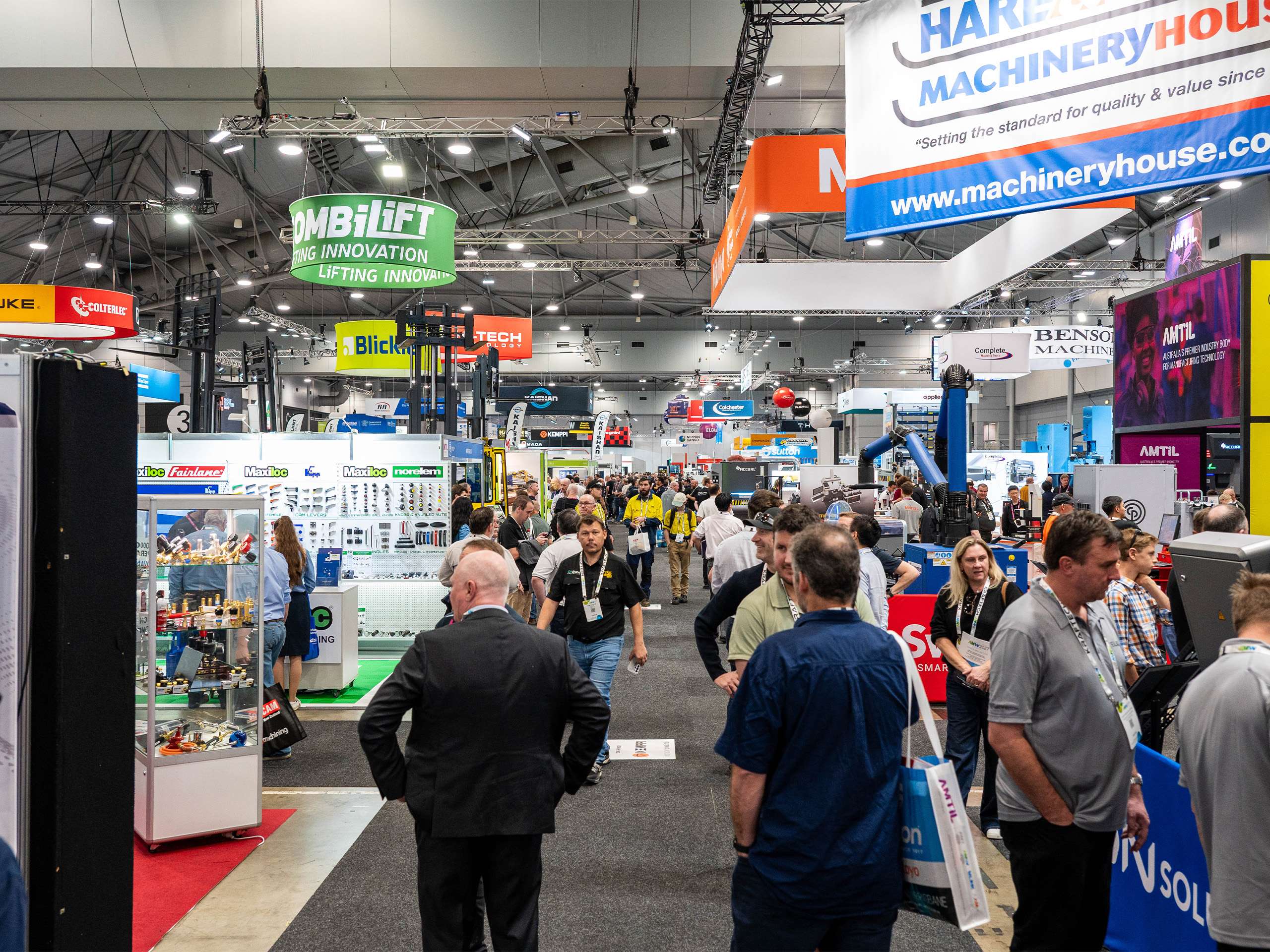
The Additive Zone at Australian Manufacturing Week again showed how far additive manufacturing has moved beyond curiosity and into practical production.
**This story originally appeared in the July 2026 edition of AMT Magazine**
This year’s exhibitors—from Emona Instruments, iO3D Printing, and Laserman Australia, through to the Additive Manufacturing CRC, 3D Solutions Australia, Shining3D Tech and RAM3D—gave visitors a close look at the materials, machines, services and research pathways helping manufacturers adopt AM with greater confidence.
The tone was noticeably practical, with exhibitors focused on where AM delivers commercial value, how to match materials and processes to applications, and how to integrate the technology into existing workflows. The emphasis was less on AM as a standalone technology, and more on how it can support faster product development, short-run production, complex geometries, supply chain resilience and customised manufacturing.
Emona Instruments’ focus was on helping Australian manufacturers identify the additive manufacturing technologies best suited to their applications, from polymers and composites through to metals and printed electronics. The company’s message was that AM is not simply about the machine itself, but about understanding the right process, material and workflow to move from experimentation to practical production capability.
For iO3D Printing, the message was grounded in real production experience. Nicholas Carroll explained, “Our primary business is manufacturing custom orthotics for podiatry patients, with spare printer capacity used to provide third-party 3D printing services. We focus on prototyping and production runs.”
The company prints in materials including polypropylene, PA11 and PA12, allowing customers to select materials according to the properties required for different parts. “The nature of our print is you don’t need any structural support because the part is suspended in powder,” Carroll said. “You’ve got fully articulated parts you can print that spin and rotate.”
A major theme was that while AM is now a proven industrial technology, but successful adoption still depends on clear use cases, a strong business case, the right skills and a pathway to scale.
Simon Marriott, Managing Director of the Additive Manufacturing CRC, said skills remain one of the key barriers to wider adoption. “A big challenge at the moment is skilled staff who know how to run machines and operate in a production environment. That is a bottleneck for many organisations looking to get into production.”
For manufacturers already using AM, the lesson was to treat the technology as a practical tool for faster iteration. Jonathan Tighe, Head of Industrial Design at Intellidesign, said his advice to design teams is simple: “Print aggressively. Treat it like paper. If you’ve got an idea you want to print and try, don’t hesitate.”
“What that means for our customers is they see their ideas coming together quicker and faster. The mistakes, challenges and problems come to the surface sooner, and you’re in a much tighter evolution,” said Tighe.
AM is clearly helping to solve production problems, shorten development cycles, reduce waste and create new product possibilities.