



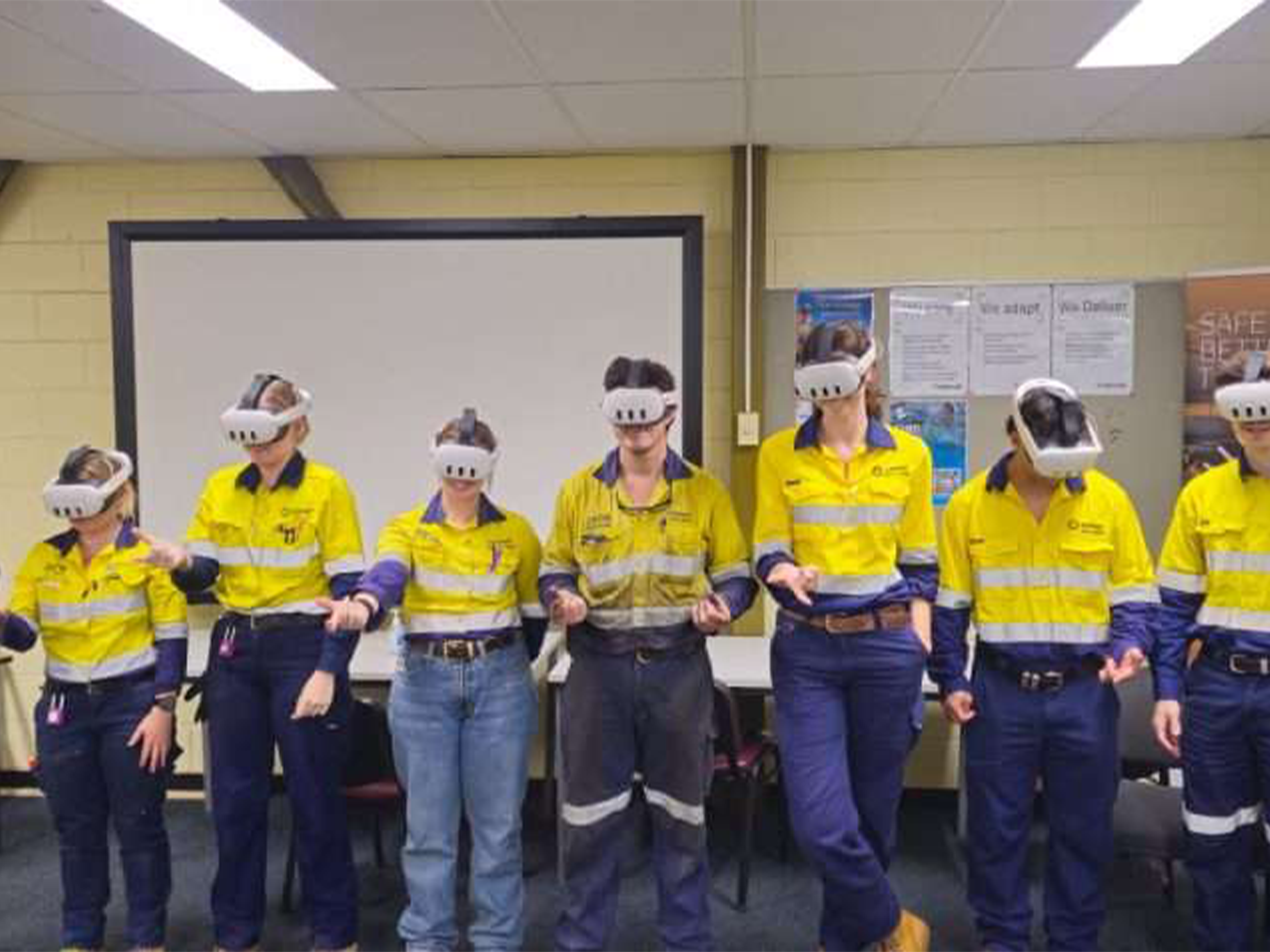
The world of virtual reality and immersive technologies have reached critical maturity — and manufacturers have something practical to gain, Composit director Ben Breitenstein says.
**This story originally appeared in the April 2026 edition of AMT Magazine**
Virtual and augmented reality offerings, now more commonly called immersive technologies or extended reality (XR), have long sat in the background of industrial innovation but rarely at the centre of manufacturing workflows.
Instead, the clunky headsets have long been a stable at trade shows, used for a virtual tour of an offshore platform or production facility, or to play a quick game guiding a golf ball into a hole.
But industrial designer and Composit director Ben Breitenstein says that play time is over, and it’s time for manufacturers to reassess what extended reality (XR) and other immersive technologies can offer to the workplace.
“VR is the best tool for some jobs,” he says. “It’s just not the best tool for every job. The issue is most people only ever saw the gimmicks.”
When consumer virtual reality (VR) headsets first hit the shelves between 2014-2016, gamers, businesses and every willing tech-head was promised a revolution that never quite arrived.
Part of the problem, Breitenstein says, was the state of the hardware – those clunky headsets powered by smartphones slotted into a plastic shell, which only had the impact of making the user dizzy.
“The fidelity in terms of movement tracking and visuals just wasn’t there. Roller coaster demos and similar flashy experiences made a lot of people sick – and that stuck.” When those same people are offered a headset today, the instinctive response is still, “No thanks, that stuff makes me dizzy.”
At the same time, public attention moved on – first through the COVID-19 pandemic, then to AI and other trends.
But while this was happening, XR was not standing still, Breitenstein says, with improvements in optics, tracking, processing power and software making today’s XR, VR and augmented reality (AR) offering significantly different to previous versions.
“Hardware is cheaper, more comfortable, and doesn’t need a high-end PC,” he says.
“Development tools have matured. Open standards like OpenXR and WebXR mean you don’t have to build a different app for every single headset. All those little friction points are getting ironed out.”
To clarify the difference between VR and AR, Breitenstein says that VR typically involves the creation of a complete synthetic environment.
“You can’t see anything but what’s in the headset. It’s good for selling the idea that you’re somewhere you’re not, basically interacting with a fully virtual environment,” he says.
“With augmented reality, you have vision of what’s right in front of you with some sort of overlay or augmentation. People often forget that can be audio as well,” he adds.
These can be seen in the recently launched Meta AI glasses, which come equipped not with a display, but an AI assistant that communicates with the user through speakers.
If that sounds familiar, Breitenstein argues the context has changed. XR is no longer a siloed novelty; it is quietly merging with the web.
“The internet is slowly going to become more and more three‑dimensional,” he says. He points to mainstream cases.
“In January, Toyota released their new HiLux. If you go on their website you can spec it out with every option, tap a button, and hold your phone up to see it parked in your driveway,” he says.
Today, spectacles retailers have normalised virtual try‑on tools, brands use 3D product models in browsers and even modern video games like Roblox and Fortnite are designed to be played on almost anything from a tablet to a desktop computer – optimising uptake and encouraging brands to develop a presence on the platform.
But none of this explains why manufacturers—typically cautious adopters—should take XR seriously now. For Breitenstein, the answer is maturity. “When the current wave of VR sprung up again ten years ago, companies could charge an arm and a leg to develop this stuff because it was so specialised,” he says.
“The pipeline of development has just become so much easier and smoother and quicker.”
Hardware has improved across the board, reducing nausea, streamlining setup, and letting standalone VR headsets run experiences without a high‑powered PC, he says.
But equally important is standardisation. “There are collaborative open standards that enable things like VR experiences you can run in a browser,” he says. “As long as the players adhere to those standards, you get interoperability.”
In practical terms, this means developers no longer need to build separate versions of an experience for each headset. Device‑agnostic formats also fold XR into existing software ecosystems.
“If you’re a computer aided design (CAD) or computer aided manufacturing (CAM) guy drawing things in SolidWorks all day, SolidWorks has its own built‑in VR mode. If you have the hardware, you can view your parts at the right scale in 3D in front of you. It lets you skip the step of having to 3D‑print the thing just to get a sense of true scale.”
That immediacy is the shift manufacturers often underestimate, Breitenstein adds.
“Until you’ve tried it, it’s really hard to understand what I’m talking about,” he says. “It’s a real level‑up in terms of understanding 3D design and spatial technology.”
With the technology stabilised, Breitenstein sees three core use cases manufacturers can exploit immediately: design, training, and sales.
Design is the clearest, he says, with the immersive tools helping remove the abstraction inherent in computer aided design.
“Anything that’s spatial in nature, anything three‑dimensional—it’s just a no‑brainer to view it at accurate scale and move through it,” he says.
“Anybody who’s used CAD knows you spend your time zooming in, zooming out, rotating, trying to get a sense of detail. Through a stereoscopic display, it’s instant.”
Breitenstein looks back on some work his company, Composit, did with the University of Queensland to illustrate the point.
“They were designing medical tech for people with artificial hearts. They sent us a handful of their CAD models and within a couple of hours we dropped them into the engine. We sent back an experience where they could pick up the parts, snap them together, and connect and disconnect cables. If you took the cable out it would say, ‘Cable disconnected’,” he says.
Beyond visualisation, the designers could feel assembly logic: how many parts they needed to hold at once, whether something made ergonomic sense, and how components related, Breitenstein adds.
“When you see it in the correct scale, you know instantly. You can’t see the forest for the trees in CAD,” he says.
Instead, the CAD models and other 3D data have a lot of potential in the world of XR.
“That 3D data lends itself to VR and AR. Most of the time currently it’s not used beyond CAM programming and renders. But it’s essentially a digital twin, and it has a lot of different use that’s not being utilised,” he says.
For training, Breitenstein says XR offers a real opportunity for training in hazardous environments and in working on anything that requires some muscle memory, citing his own memories of working on laser cutters and brake presses.
“I wish we’d had something that could teach somebody in a practical way—walk them through the checks for being inducted to use that machinery. Being able to stand there, use your hands, practice the thing, maybe get it wrong a few times, and run through it again—it’s a much better way to learn than reading a manual or clicking through a PowerPoint,” he says.
Breitenstein is enthusiastic about the Meta AI glasses and similar smart glasses as a tool for training.
“I bought a set of the Meta Oakley smart glasses and within a couple of months I was using them practically a lot more than I thought,” he says.
“It’s liberating to tap the button, start recording, and explain what you’re doing with your hands free.”
For industries with ageing workforces and tacit knowledge, the implications are obvious.
He imagines pairing recordings with a workflow tool that enables quick documentation. “The difference between holding a phone and doing it with glasses is a quantum leap.”
Sales, meanwhile, benefits from virtualising the un‑transportable. “It’s easiest to justify when you have products you can’t just throw in a van,” he says. Composit built a virtual showroom for a client selling large architectural lighting – allowing a client to see the potential size of a light fitting in relation to the room.
Breitenstein stresses that XR does not replace fundamentals—it simply removes an abstraction layer. “Any other medium is highly abstracted,” he says. “We’re trying to remove those layers and get people closer to doing the thing one‑to‑one.”
Define the problem first, he says, and the pathway becomes obvious. “Otherwise you end up like a hammer looking for a nail.” For those wanting to explore, he offers a simple step: “Just get yourself in a headset. Something modern. Not a phone from 10 years ago.”
At AMW, that’s exactly what he plans to demonstrate. “We’ll have a series of headsets showing different experiences—design, training, sales… It comes back to figuring out what your problem is. Then we can figure out how to solve it.”