



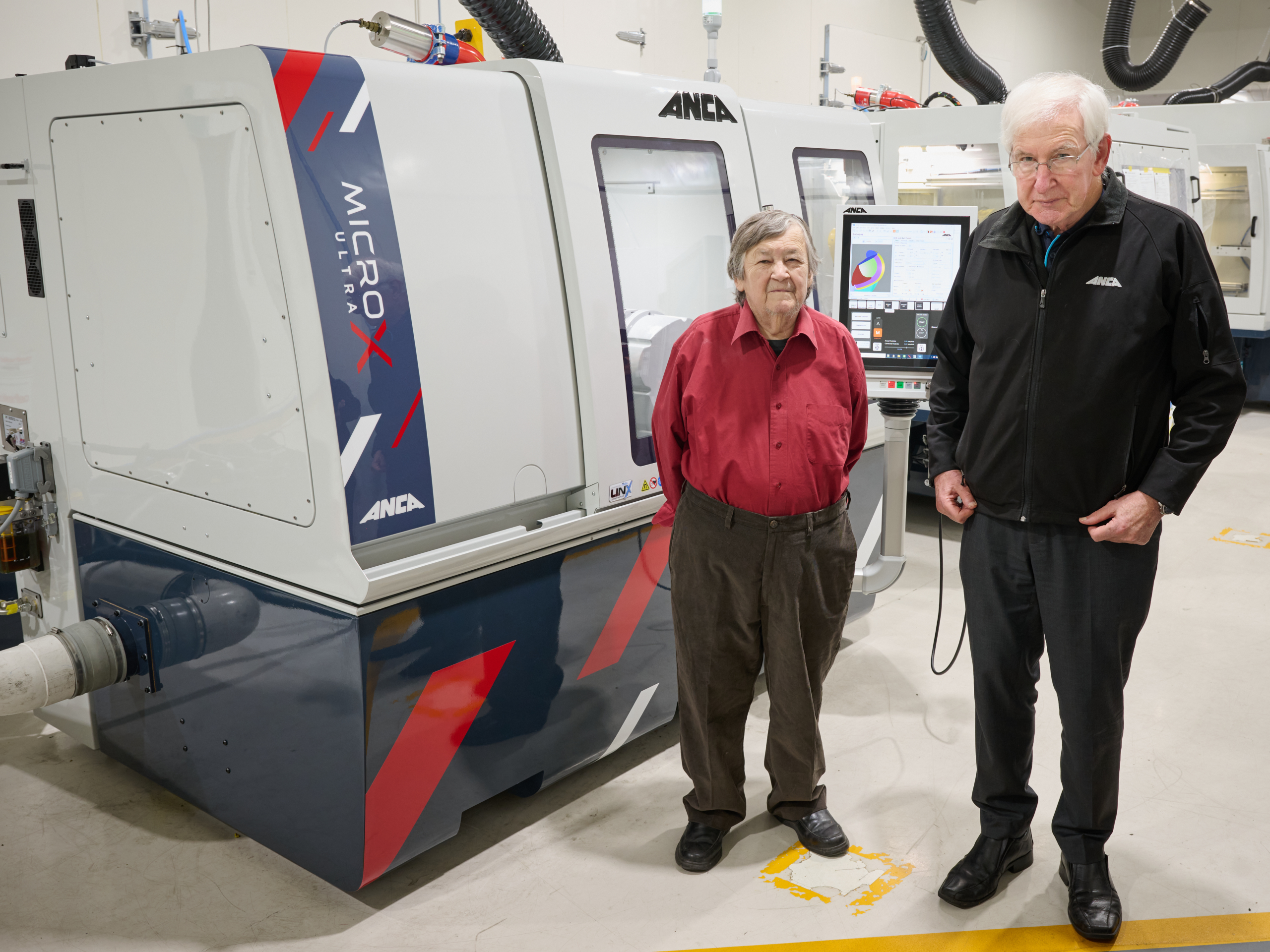
How two Australians built a leading global manufacturer—ANCA co-founder Pat Boland gives his advice for the next generation.
**This story first appeared in the October 2025 edition of AMT Magazine**
In the world of advanced manufacturing, few Australian companies have achieved the global reach and reputation of ANCA. Founded in 1974 by Pat Boland and Pat McCluskey, ANCA has grown from a local startup to a world leader in CNC tool grinding machines, with a legacy of innovation and customers spanning the globe.
As a leading manufacturer, ANCA co-founder Pat Boland knows that in a changing world some constants remain – the need for vision, adaptability and an ongoing focus on people.
“The world is very different now, compared to what it was when we started – and possibly the biggest changes have been in communications,” he says. “When we started our exports the Telex was the top method of communication internationally – and then what a fantastic invention the photocopier and fax machines were.”
Today, with the accessibility of the internet and new artificial intelligence, Boland says the concept of a “home market”, partially isolated from the rest of the world, is gone.
“You can communicate effortlessly throughout the world … but it also is a challenge in the sense that everybody else can exploit that communication as well,” he says.
“So I think the key element to our success is to pursue the world market – don’t really worry about the local market – though exploit it if you can… the world market is where the volume and returns will be.” It was a lesson that Boland and his co-founder, Pat McCluskey, learned early – when the first of the recessions of the 1980s hit the nascent company hard.
“We didn’t get a single order for six months, which taught us an awful lot about doing business,” Boland says. This crisis forced a pivotal decision: to look beyond Australia’s small market and focus on global opportunities.
The two men had founded ANCA in 1974 after meeting at an ammunition factory in Footscray, Melbourne, and deciding to combine Boland’s mathematics and software expertise with McCluskey’s practical engineering know-how.
With this change in circumstances, ANCA moved beyond its initial business of fitting CNC controls to machine tools.
“We were building computer controls where you had to find somebody who had a machine that they wanted to control – and there weren’t that many in Australia, and it is very difficult to export,” Boland says. “The Australian market was too small for our sort of speciality. We had to really try and look globally if we were going to survive.”
Embracing Global Markets
ANCA’s leap into overseas markets, particularly the United States, was a turning point. By partnering with fellow Australian company Laser Lab and leveraging existing infrastructure, ANCA established a foothold in Detroit’s manufacturing heartland.
This later led to the opening of ANCA’s first overseas branch in Novi, Michigan, in 1986, before later expansions into England, Germany, France and Italy, with the company’s first China office opening in 2004. But global expansion was only part of the equation. Innovation became ANCA’s hallmark.
The company shifted from making OEM computer controls to developing end-user products, most notably CNC tool grinding machines. “Our technology has been a key part of our success. If we don’t have something to offer our customers which is in some ways better than the local competition, we’re not going to be successful,” Boland says.
Today, ANCA is renowned for its cutting-edge solutions, including its Ultra range, producing endmills and other cutting tools of high accuracy and quality. “There’s some deep underlying technology we’ve developed which has been giving us fantastic performance results with our machines – and getting that across our entire product range and fully exploiting it in the market is our major current effort,” he says.
But even going back to the pivot from OEM to end-user products and ultimately into CNC tool grinding, Boland says a connection with customers is what has driven the company’s decision-making processes.
“I’m trying to think of an occasion when it wasn’t people at exhibitions approaching us directly, or our sales people finding an unfulfilled need, or an area where our expertise can be applied,” he says. ANCA’s willingness to diversify has always been guided by customer demand, and in meeting that demand, ANCA invests heavily in pre-sales and after-sales support for customers worldwide, striving to “look as much like a local company as possible.”
Whether in Germany, the US, or Australia, the goal is to provide the same high level of service as local competitors. “It’s not easy, but it’s something we aspire to,” Boland says.
That said, Boland adds that the company is proud to keep its home base in Australia. “We are actually an Australian company – the owners are Australian, our key engineering functions and marketing functions are all done locally,” he says. “That’s where we are, and to give that up, that is not something which has ever made sense.”
For ANCA, success is as much about people as products.
The company’s apprenticeship program, officially launched in 2011 after the company took on its first apprentices in 1987, is a testament to its commitment to staff development.
“A number of our key managers actually started as apprentices,” Boland notes. “It gives you the opportunity for really training staff exactly how you want them to be trained.”
Boland believes that providing a satisfying, challenging environment is key to retaining talent. “It’s a challenging technical area where they can use their skills, develop their skills, and continue to develop their skills,” he says. Embracing new paradigms like AI and offering ongoing training ensures that staff remain engaged and innovative.
The same is true for ANCA’s new 2025-2030 Sustainability strategy, launched in July, which has seen the company commit to reducing its Scope 1 and 2 greenhouse gas emissions by 42% by 2030 from a 2023 baseline, and to cutting Scope 3 emissions by 25% in the same timeframe.
“In particular in Europe now it’s becoming sort of a mandatory requirement,” Boland explains, likening the shift to the rise of safety standards decades ago.
“You don’t have a choice. You really have to go down that path, apart from being what you want to do from a sustainability point of view. It’s a key part of being in the market in the future.”
Looking back, Boland says his greatest pride comes from seeing ANCA’s machines in factories around the world, from China to Germany to the USA.
“We had our 50th celebrations last year, and at one of the gatherings we had in the USA, we had a customer come to us and say he’d built his business on ANCA machines – and because of our product, he and his family had been able to live the American Dream,” Boland laughs.
“It’s great to visit a customer in Germany and see 30 of our machines in the line all working… seeing happy customers in Japan, in Switzerland, in the USA – and to pick up an iPhone and know that we played a part in the supply chain of an iPhone or iPad or Samsung phone, it’s great – highly satisfying,” he says.