



How industrial 3D printers can transform the metal forming industry
The metal forming industry relies heavily on precision, durability, and cost-efficiency.
Traditional manufacturing methods, such as casting, milling, and forging, require extensive tooling, long lead times, and significant financial investments. 3D printing is revolutionising this space by enabling rapid prototyping, tooling production, and custom part fabrication at a fraction of the time and cost.
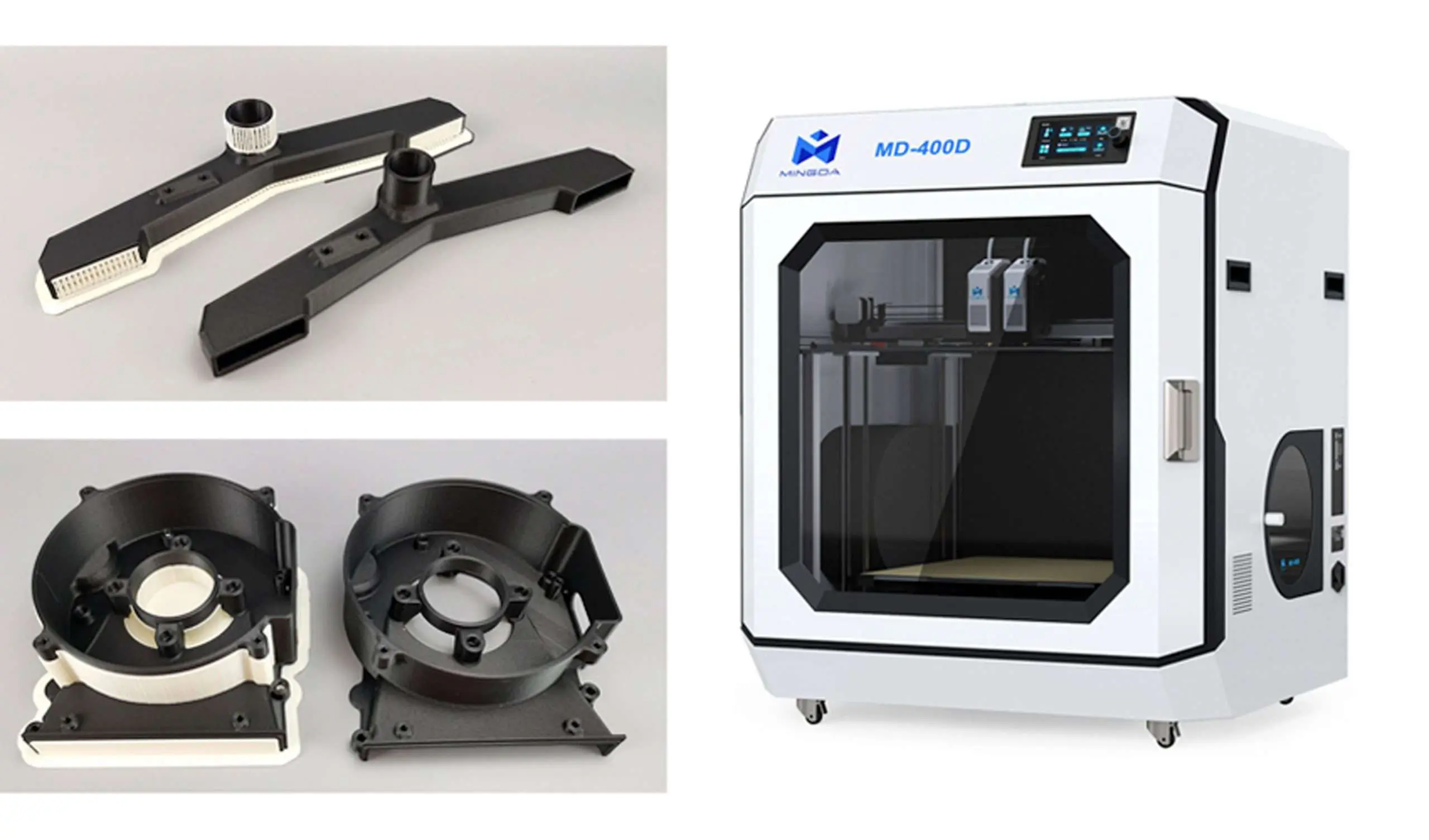
The new Mingda industrial 3D printer range—featuring the MD-400D, MD-600D, and MD-1000D—is particularly well-suited to support businesses in the metal forming sector and the manufacturing industry. These printers offer large-format capabilities and exceptional material versatility, enabling companies to digitise their production workflows and minimise reliance on expensive traditional tooling.
Key benefits
- Rapid Tooling Production: Print cost-effective tools, dies, and fixtures quickly for testing and small production runs.
- Large-Scale Prototyping: Create full-scale prototypes with massive build volumes, reducing lead times and costs.
- Support for Composite Tooling: Use advanced materials like carbon fibre-reinforced filaments for strong, lightweight tools.
- Customisation and Low-Volume Production: Produce bespoke parts and tools without additional tooling costs.
- Open-Material System: Experiment with various filaments to meet specific mechanical and thermal requirements.
- Cost and Time Savings: Lower production costs and speed up workflows compared to traditional methods.
- Reduced Downtime: Print replacement machine components on-demand to keep operations running smoothly.
- Consolidate Components: Combining several components into one reduces assembly steps, minimises complexity, and shortens production time.
- Overflow Production Capacity: Ability to create additional tooling when a production line is at its limit.
Applications:
- Forming Dies and Moulds: Companies can 3D print prototype forming dies using composite filaments to test designs before creating expensive final metal dies.
- Jigs, Fixtures, and Gauges: To support manufacturing workflows, custom assembly tools and quality control gauges can be rapidly produced.
- Machine Tooling Prototypes: Before machining precision tools, companies can test the dimensions and tolerances using full-scale 3D printed prototypes.
- Custom Replacement Parts: Manufacturers can quickly produce replacement components for metal-forming machines, reducing downtime and costs.
- Prototype Metal-Formed Components: Large-format printers like the MD-1000D allow companies to print prototype parts for validation before the expensive metal-forming process begins.
By adopting these printers, companies in the metal forming industry can digitise their workflows, achieve greater agility, and maintain a competitive edge. The Mingda MD Series of 3D printers offers a powerful, versatile solution for businesses seeking to reduce costs, enhance efficiency, and unlock the full potential of additive manufacturing. Whether your focus is on rapid prototyping, custom tooling, or large-scale production aids, the MD-400D, MD-600D, and MD-1000D are designed to deliver the precision, reliability, and flexibility needed to stay ahead in today’s competitive manufacturing landscape.
Interested in learning more about how the Mingda 3D printers can transform your business? Contact Bilby3D today to explore your options and discover the perfect solution for your metal-forming needs!