



Switch-mode systems can lower costs and power consumption while improving visibility for asset owners
Steel fabricators may not think much about corrosion after completing their work. However, major infrastructure like wharves, bridges, pipelines, and tanks is constantly threatened by corrosion, which, if it takes hold, will make them unsafe. Traditionally, phase control cathodic protection (CP) systems were used to protect infrastructure, but these come with several challenges, such as the high cost of copper cabling and associated power loss. These issues become even more significant for asset owners who must address environmental, social, and governance (ESG) reporting. Here, David Celine, managing director of cathodic protection specialist Omniflex, explains how CP system design can support ESG commitments while simultaneously reducing costs and enhancing maintenance capabilities.
At the core of any impressed current cathodic protection (ICCP) system is a transformer-rectifier unit (T/R), which provides the essential electrical current for ongoing protection. There are two primary types of T/R that can be employed to supply current for an ICCP system: phase control and switch-mode.
While both technologies are hugely important to the global CP market, it is not always clear which is best to use for a specific project.
In phase control CP systems, AC power passes through a large AC transformer, which is then rectified to produce a controlled DC output for the anodes. In switch-mode systems, AC power is initially rectified to high voltage DC power, followed by the use of much smaller high frequency transformers and rectifiers to create controlled DC outputs. This technique enables the generation of smaller and more efficient outputs that can be more easily regulated.
Phase control systems have traditionally been the preferred choice for CP consultants around the world. However, as ESG commitments grow in significance for asset owners, switch-mode systems are becoming an increasingly appealing alternative, particularly for concrete structures, where a greater number of small zones require protection.
CP system design supporting ESG
Strong ESG practices help to mitigate environmental risks, like corrosion and climate change impacts, ensure worker safety, and promote transparent, data-driven decision-making. Moreover, ESG initiatives align operations with global sustainability goals, reinforcing a commitment to preserving resources and fostering resilience in critical infrastructure.
The reduction of CO2 emissions and improvements in electrical power usage efficiency are significant factors in ESG reporting. Switch-mode CP systems outperform their phase control counterparts in this regard.
A phase control system running at 100% capacity is, at best 80 to 85% efficient. However, because of oversizing, systems never run at anything close to 100% capacity. In real-world applications, phase control systems operate at a peak of 60% efficiency.
Furthermore, as phase control systems rely on a single large T/R to distribute current across a whole structure, they require extensive copper cabling for use. This is both extremely expensive and causes power loss. It is not uncommon for a phase control system to lose around half its voltage in the cabling, which can further reduce the efficiency down to 30%.
In contrast, switch-mode CP systems consistently operate at 90% efficiency, even when running at 50% capacity. This means that overall power consumption is dramatically reduced compared to phase control systems.
Small, compact switch-mode T/Rs also make the technology ideal for use in distributed CP systems on large structures, where locating T/Rs closer to the anodes provides significant savings in installation costs due to reduced cabling and lower energy costs due to reduced volt drops in the cabling.
Because switch-mode systems can use smaller T/Rs that are closer to each individual anode, the copper losses are largely eliminated. As a result, over 80% of the power reaches the anodes in switch-mode systems.
Regarding system installation, the distributed nature of switch-mode systems means that costs are greatly reduced compared with phase control systems. Also, CO2 emissions are massively reduced when switching-mode systems and, in many cases, can be less than half of the emissions generated when installing a phase control system.

Supporting ESG with remote monitoring
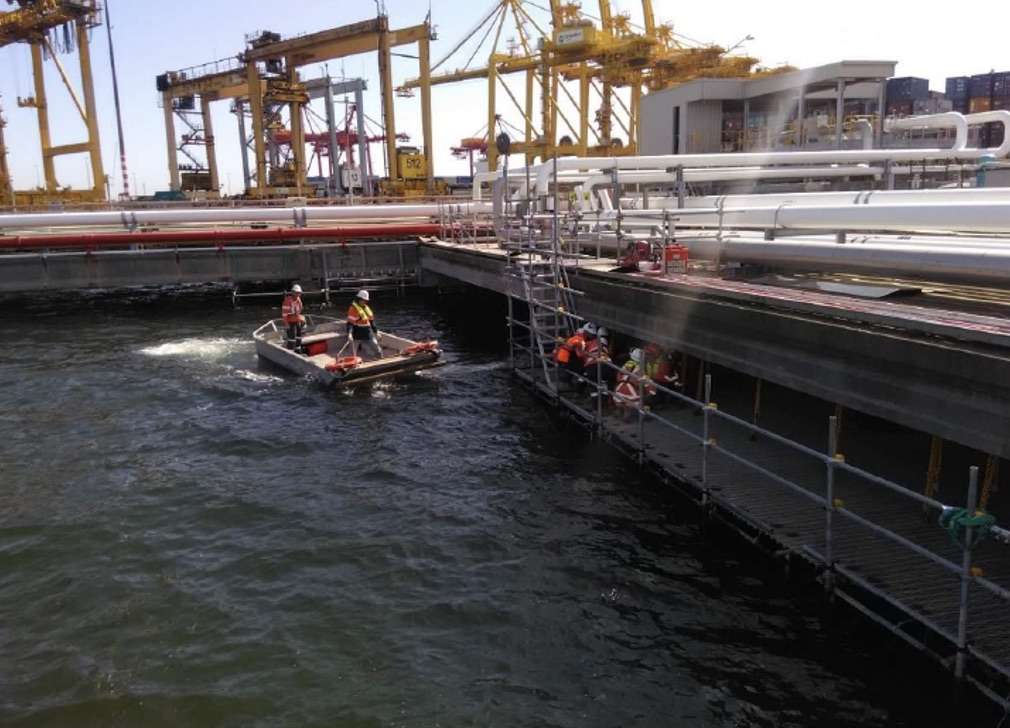
Large CP systems generally include numerous anodes that require monitoring and control, and switch-mode technology enables each one to be managed individually. For instance, a typical concrete wharf structure might have hundreds of anodes along its length, and each requires individual monitoring and adjustment over time. Relying on traditional manual system inspections and adjustments is a costly and risky endeavour, due to the lengthy completion time, often in hazardous locations like beneath a wharf in a boat, and the expense of hiring a qualified technician to perform this work.
This is where a switch-mode CP system combined with remote monitoring becomes essential. Implementing this technology alongside switch-mode CP systems provides three significant advantages for port asset managers that conveniently align with enhancing ESG practices.
However, remote monitoring is not solely for new installations. It is now also possible to retrofit existing cathodic protection systems with remote monitoring and control.
This gives asset owners continuous access to real-time data, including total power consumption, anode current outputs, reference electrode test data, and anode health status. With ongoing access to this live data, engineers can swiftly identify abnormalities and resolve any issues before they escalate, ensuring ongoing protection of assets.
Next, they will experience lower ongoing maintenance costs as the need for site visits and physical inspections is significantly reduced. For instance, a typical CP installation without remote monitoring is inspected twice a year, consuming considerable on-site time for readings. In contrast, the same CP system monitored remotely requires only a visual inspection once a year, with much less time spent on-site taking readings, thus lowering operational costs.
Finally, remote monitoring enhances personnel safety. Critical protected infrastructure is often situated in hazardous and hard-to-access environments, and remote monitoring reduces the necessity for technicians to physically visit these locations, thereby improving overall safety. By minimising on-site inspections, the risk of accidents and injuries is significantly diminished.
Omniflex’s CP systems and remote monitoring options enable asset owners and site managers to oversee the ongoing system status and gather real-time data, promoting data-driven decision making across the board. They are also designed for CP consultants to perform all necessary specialised cathodic protection testing remotely and to adjust output currents from afar, eliminating the need for site visits or manual inspections, thereby reducing costs and enhancing asset protection.
In an increasingly ESG-conscious world, adopting a CP system design that lowers costs, power consumption and CO2 emissions while providing more data for owners and managers and improving worker safety is a no-brainer.