



How Air Liquide’s pure oxygen technology helped breathe life into a major land-based aquaculture project
**This story first appeared in the October 2025 edition of AMT Magazine**
Beloved by sushi chefs and recreational fishers alike, the Kingfish – also known as the Yellowtail, Haku or Kingi – attracts market prices comparable to salmon and is found in plentiful numbers off the coast of Australia and New Zealand.
For the team at New Zealand public research organisation the National Institute of Water and Atmospheric Research – today known as Earth Sciences New Zealand (ESNZ) – the fish is also an ideal candidate for commercial farming. Of course, New Zealand is far from the only nation developing markets for the fish, with hatchery production now well established in Australia, the Netherlands, Denmark, Chile, and Mexico.
Until recently, ESNZ said, most on-growing of the fingerlings born in these commercial hatcheries was done in sea-cages, until the fish reached their market size of 3kg. But to truly take advantage of what it saw as a lucrative opportunity, the team at ESNZ worked on technology to support commercial-scale hatchery production in a land-based recirculating aquaculture system (RAS).
Essential to the development of the RAS is the Air Liquide Technology Centre (ALTEC) – where technical specialists were able to provide a customisable oxygen dissolution solution designed to meet the needs of the fish at every step of the production process. ALTEC fish farm specialist for Air Liquide Pacific Tianyan Chen says the group collaborates closely] with industry to provide customised solutions and services according to specific customer needs.
Popular among modern land-based aquaculture farms, a RAS is essentially a water treatment plant that circulates reused water, Chen says. “As aerobic organisms, fish require a continuous oxygen supply to fuel their metabolic processes, which are essential for growth, reproduction, and overall physiological functions,” she says.
“This runs especially true for modern land-based aquaculture farms, as RAS circulates reused water to sustain fish cultures at higher densities. Supplying oxygen becomes absolutely critical, and a pure oxygen supply is a must for a fully closed RAS”
“When dissolved oxygen levels in the water fall below a critical threshold (causing a condition known as hypoxia), fish experience stress, leading to a cascade of negative effects. These include a reduced appetite, which consequently slows their growth rates,” she says.
“Furthermore, hypoxic conditions compromise the fish’s immune system, making them more susceptible to various diseases and parasitic infestations.
“If the dissolved oxygen levels remain critically low for an extended period, it can ultimately lead to significant mortality events, resulting in substantial economic losses for aquaculture farmers,” she says.
Perfect Balance
Chen says that maintaining optimal levels of dissolved oxygen allows the fish to gain more weight for each unit of feed they consume – enhancing growth rates and reducing the total amount of feed needed, which in turn lowers operational costs and minimises waste production.
“Some farmers have reported that their feed intake has increased by 20-30% and the feed efficiency from feed to fish meat/growth also increases significantly, which results in production profit gains,” Chen says.
Air Liquide Tech
With fish feed costing more than A$3,600 for one tonne of fish – depending on the types of fish and feed – this sets the scene for a substantial cost saving.
Chen says oxygen is also used to produce ozone, used to sterilise the breeding water, which is passed through a series of filters before being returned to the fish basins.
“It’s also important to note that the specific oxygen requirements can vary significantly between different fish species. Species native to fast-flowing, oxygen-rich waters are susceptible to even slight reductions in dissolved oxygen levels. RAS requests higher O2 supplement versus Flow-through farm due to no continuous natural oxygen due to water reuse and higher fish density.”
“Therefore, it is necessary to carefully consider the specific needs of the species being cultivated to ensure that the oxygen supplementation strategy is tailored accordingly,” she says. While aeration using air is a common method of supplying oxygen to fish, the resulting oxygen concentration depends on environmental conditions, as air only contains about 21% oxygen – the rest is mostly nitrogen.
“Pure oxygen allows for higher fish density while requiring less water, creating more sustainable operations,” Chen says.
“Oxygen is usually dissolved in each fish basin, and the water enters the fish tank. This dissolved oxygen concentration is increased to 120~140% saturation level according to the amount of biomass,” she says. “As a result, the oxygen needs of the fish are met, providing a stable environment for safe and productive fish production.”
Oxygen dissolution systems are also more energy-efficient than conventional aeration methods, she says.
“We offer a true consultative partnership to farmers, combining deep industry expertise with a hands-on approach. Through that angle, our experts conduct on-site assessments and trials and design the most suitable solution to achieve the objectives of a farm. We also ensure the seamless integration of our gas solution and system into the farm’s operations.” Chen says.
“For both RAS and flow-through fish farms, we offer energy-efficient oxygen dissolution systems. These systems can integrate with existing aquaculture infrastructure and include high-efficiency dissolvers like HappAL Fish-1, Bicone, Oxyflow, and Oxyfox-SC, as well as electricity-free options such as Poroxal.
“At Air Liquide, we pride ourselves on innovating with and for our customers. Our teams develop new oxygen dissolver devices to meet the specific needs of our customers, complementing our existing equipment solutions,” she says.
New horizons
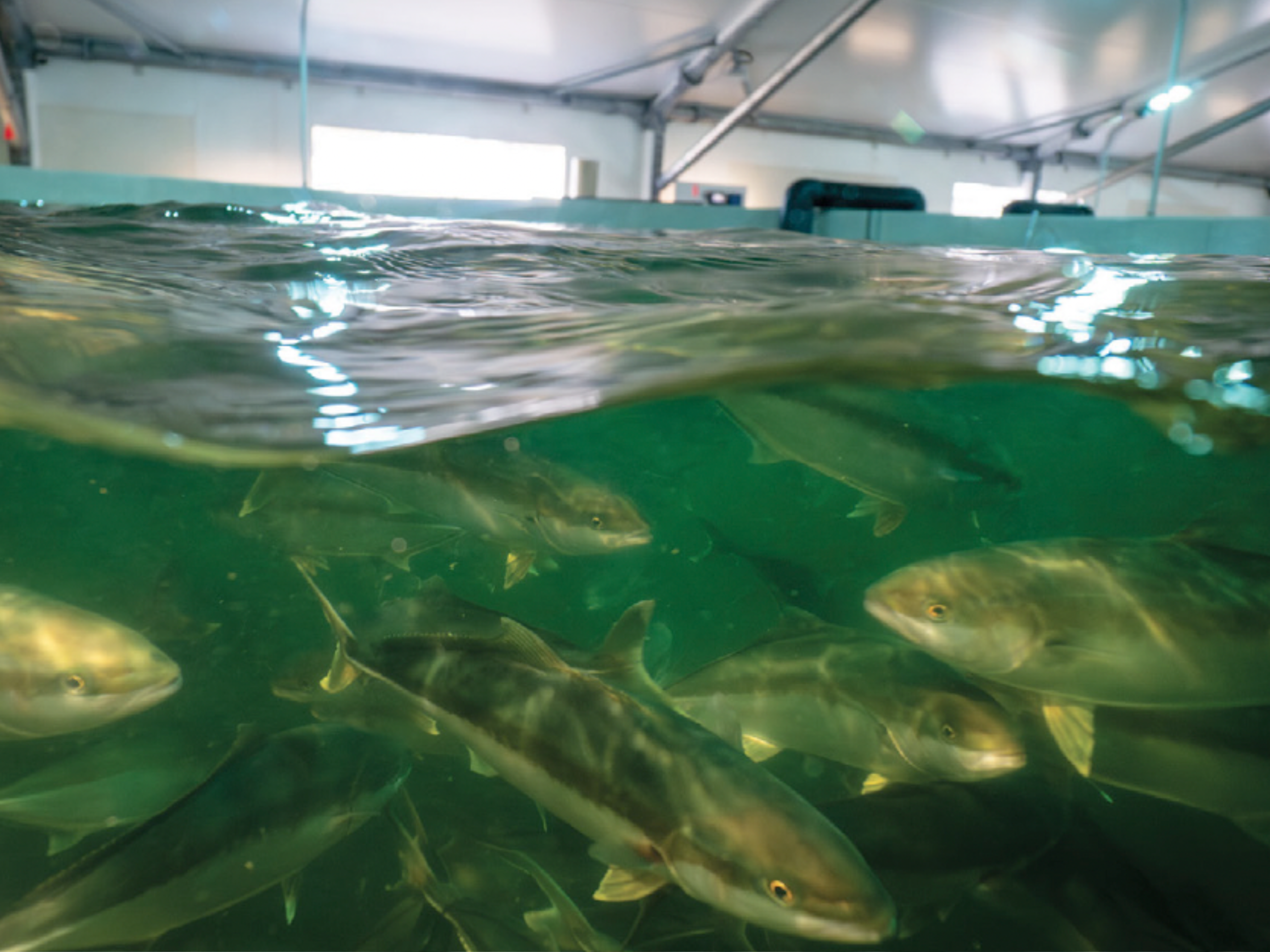
Built in collaboration with the Northland Regional Council and based in the coastal town of Ruakãkã, the RAS facility at the ESNZ-supported Northland Aquacultre Centre helps the kingfish reach market size within 12 months of spawning, ESNZ says. Today, the facility produces up to 600 tonnes of kingfish per year, with between 95-98% of the water cleaned and reticulated through the system.
“[Kingfish] thrive in RAS; circular tanks suit their natural schooling and feeding behaviour. The systems for exchanging and refreshing the water are engineered to ensure a consistent, healthy rearing environment,” ESNZ says.
At the facility’s opening, ESNZ chief executive John Morgan said the facility will help New Zealand meet its ambitious target of recording $3 billion in revenue by 2035. “We saw a clear gap in the market for an on-land farm that produces commercial quantities of high-quality fish,” he said.
“This new facility uses a recirculating aquaculture system [RAS], which offers superior environmental and economic performance, and full control over all aspects of production.”
Moving into the future, Chen says there is a growing need to make both the oxygenation process and equipment performance more visual and reliable.
By wirelessly monitoring important parameters such as dissolved oxygen, Air Liquide aims to provide early alarms for abnormal situations, better understand operation history and obtain real-time data including calculating the oxygen usage of each unit of fish.
In the meantime, Chen says she and Air Liquide aim to continue to help with the expansion of land-based aquaculture into the future. “We are excited to see these new innovations could help the fish farming industry in Pacific and stay on our mission to understand global technology trends and contribute to land-based aquaculture” Chen says.