



Welding equipment manufacturers counter welder shortage with smarter solutions
Welding is fundamental to our world. The process of fusing pieces together, usually metals, to form a continuum is used in the construction of buildings, bridges, overpasses, railways, ships, planes, the car that you drive, domestic appliances and much more. Demand for welding skills has climbed worldwide, yet the number of welders has steadily declined, particularly in developed economies (including Australia) challenging welding machine manufacturers to continuously enhance their equipment.
Whether it is America, Canada, Europe, Japan, the United Kingdom or Australia, the demand for more welders in the Western world is staggering. According to the European Welding Federation, there is a shortage of around 300,000 qualified welders in Europe. By 2027, the US will need an additional 360,000 welding professionals says the American Welding Society. In Japan, where the overall workforce is shrinking, some 250,000 welders will be needed by 2050; while in Canada, they are experiencing an ongoing shortage of welders says CWB Group’s Welding Industry Report, 2022. In Australia, the picture is equally bleak.
According to the Australian Bureau of Statistics, 83,400 tradesmen identified as welding workers in 2012. In 2014 this figure fell to 75,800 and in 2019 to 69,600. By 2030, Australia will have a shortfall of some 70,000 welders according to Geoff Crittenden, Weld Australia’s Chief Executive.
There are several reasons for the shortage of welders worldwide and in Australia. One of the key issues is the ageing workforce. About 30% of Australia’s existing welding workforce is aged over 45. As this large proportion of older workers retire, and with fewer individuals entering the trade, the lack of welders will continue to decline.
Another reason for the shortage of welders is that many young people over the years have been encouraged to pursue a university degree rather than vocational training. According to Weld Australia, the number of students completing welding apprenticeships, including a Certificate III in Engineering (Fabrication Trade), continues to fall by as much as 23% annually.
Further, misconceptions about the welding industry exacerbate the problem of recruiting individuals to the sector. Welding is believed to be underpaid with no clear career path, and the work is monotonous and repetitive in an environment that is dirty and decrepit. Yet, welding can be creative, versatile, technologically sophisticated and well-paid. And today, welders are also often spoilt for choice with a wide range of prospective employers to choose from.
Another factor that has contributed to welder shortages is the resurgence in worldwide construction, industrial, manufacturing and mining activity post-COVID-19. According to Fortune Business Insights, increased demand in industries such as automotive, heavy engineering and construction has intensified the problem of welder shortages. And as projected government expenditure in renewables, aerospace and defence grows, demand for welders is likely to be augmented. By 2030, the global welding market is predicted to grow to US$34.18bn from US$24.73bn in 2023.
While governments, educational institutions and industry organisations attempt to grapple with the problem, welding equipment manufacturers are developing equipment and software that allow welders to weld better and do more.
Manufacturers such as Kemppi, Lincoln Electric, Fronius and others are producing welding equipment that improves welding precision, quality and performance. “With fewer welders in the marketplace, we are acutely aware that we need to empower them so that they can produce quality welds faster to meet their workloads,” said Mark Shaw, Managing Director, Kemppi Australia.
To this end, manufacturers are incorporating new and better technologies into their machines that will help increase welder productivity. These include superior arc stabilising technology for reliable and quality welding, features such as Kemppi’s Weld Assist for faster equipment setup, inbuilt welding programs, and tacking and double-pulse capability, to name a few.
Manufacturers have also developed machines for specific needs to help boost productivity, as well as machines that are industry 4.0 ready. Kemppi introduced the X5 FastMig Pulse welding system exclusively for industrial use. Lincoln launched their HyperFill twin-wire solution to revolutionise productivity in heavy fabrication and Fronius developed the TransSteel machines, especially for use on steel. The industry 4.0 ready machines can be combined with the manufacturer’s welding software to further improve welding efficiency and maximise productivity.
“The use of data analytics via welding software such as Kemppi’s WeldEye, is also helping to make the industry more productive. And with the emergence of AI, welding will become even more cutting-edge and efficient,” says Shaw.
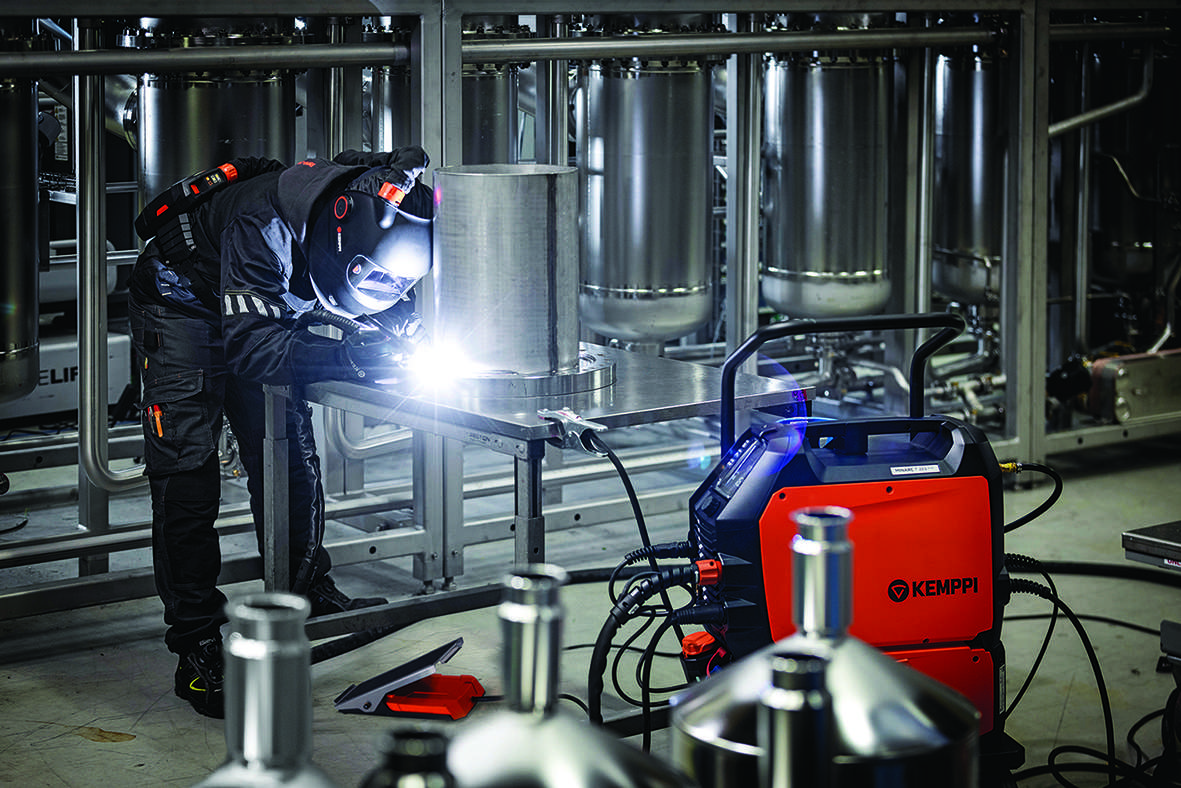
Manufacturers are also combining capabilities that have traditionally been available in two separate machines into one. Kemppi recently launched the innovative Minarc T 223 ACDC GM. This ground-breaking machine delivers high-quality ACDC TIG welding with built-in electrolytic weld cleaning. It lets welders weld and clean with one machine, in one spot, so that they can power through their welding tasks.
“We are trying to ensure that welders have the tools they require to work smarter, faster and with greater precision and this is why we are developing equipment such as the Minarc T 223,” explained Shaw.
Apart from smart standalone welding equipment, the lack of welders globally is also helping drive the development of robotic and cobot welding. “Welding equipment manufacturers are embracing welding automation,” said Shaw. “At Kemppi, we are highly invested in the development of robotic and cobot automation to help meet the growing demand for welding.”
As technology advances and this is combined with the industry’s determination to arrest the welder shortage, welding equipment manufacturers will no doubt continue to produce solutions that are smarter, more powerful and more precise.