



The fundamental principle of being competitive is to compete where you can, not where you can’t. Ray Keefe, Managing Director at Successful Endeavour
When it comes to manufacturing, Australia operates in a high-cost business environment, much like Germany. This means we’re not the ideal place for producing low-grade, low-value, and easily replicated products. This is especially true in the electronics sector. So, if you can’t compete on raw transactional costs, what can you compete on?
Eighteen months ago, we relocated to a larger design office and a separate electronics manufacturing factory in Dandenong South. Now, we have an SMT pick and place line, enabling us to produce higher volumes of products at a reduced unit cost. However, we are not aiming to become a Contract Electronics Manufacturer (CEM), and we still collaborate with established Australian CEMs such as Precision Electronic Technologies, Duet Electronics, and Entech Electronics. We are not looking to compete with them in volume manufacturing; instead, we specialise in high-quality, high-mix, low-volume manufacturing for prototypes, field trial units, and niche opportunities. While this is not the core business for the CEMs, it represents a critical area for startups and early-stage opportunities.
When I tell people we have a factory the first question I am usually asked is, “So you are cheaper”? To which the answer is, “No”. Which leads to the obvious second question of, “How can you compete if you are not cheaper”? Which implies the only thing that matters is price.
Since the core assumption above is wrong, I explain what we compete on. Here is our list of things we can compete on:
- Time – you can have a quote tomorrow and your electronics in two weeks;
- Ease of doing business – we have a full design team behind the factory;
- Single business relationship – if we designed the product for you then making it for you is very straight forward and you only need the one account;
- Test – we can design and build the test systems and because we can build them quickly this also saves time;
- Total Cost of Ownership – raw transactional cost is not the only cost, you also need to factor in the rest of them.
We also assist our clients in becoming more competitive by taking into account the needs of all stakeholders. A successful product must adequately address the requirements of every stakeholder. Therefore, it’s essential to consider this. Production is a stakeholder, and to manufacture a product cost-effectively, you need to ensure the design is suitable for manufacturing. In Australian electronics manufacturing, this entails minimising labour content, reducing rework or scrap, and incorporating as many features as possible in software to lower the hardware bill of materials. Considering production assembly and testing from the outset of a project will provide it with the necessary priority.
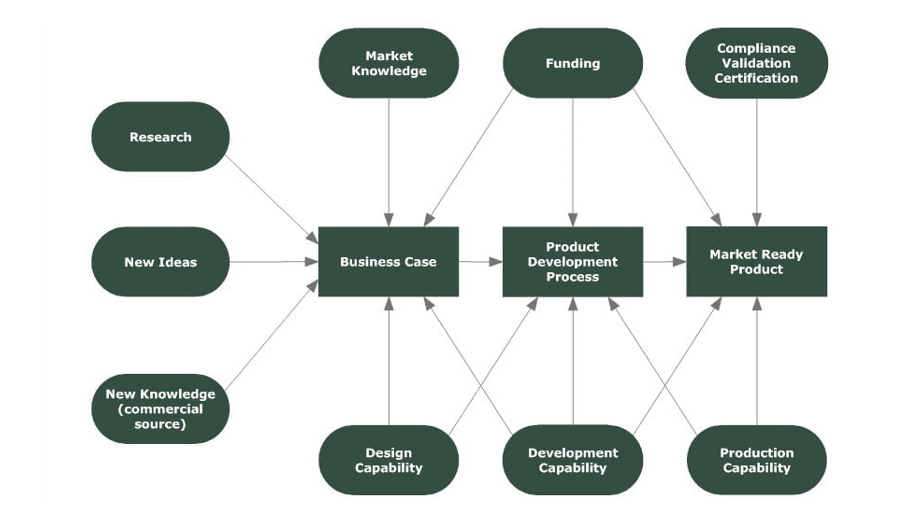
Other areas are also important, including how the product is sold; the installation, configuration, or commissioning process, if applicable; its usage; field support; and service management. The title image (above) is a bit of a map outlining the typical stakeholders involved in getting the product ready for market. There are additional stakeholders beyond this, including some of those mentioned above.
You will notice that Funding and Development Capability impact the most areas. Which leads to the following considerations:
- How are you funding the project and is that enough to get you to a successful product?
- Are you working with the right Design Partner?
The second question also intersects with funding because you can save money by choosing a Design Partner who can’t do the job, but you really didn’t save money because you didn’t get to the finish line.
This does not mean that spending more automatically gets you better results. Just that you need to spend the right amount. We find there is usually a primary pressure point on the project, and it is either:
- Cost – either development budget or unit cost?
- Time – how quickly do you need the product ready for market?
- Performance/Features – how well does the product need to work?
The usual rule applies. You can optimise a project around one of these as the primary priority, but not all of them.
I encourage you to think more broadly about being competitive and all the levers available to you. And then compete where you can best compete.