




Scandium is one of the world’s rarest, and consequently most valuable, critical. Current prices on the Shanghai Metals Market range between US$3,000-3,500/kg, approximately 1.5 times the value of silver.
**This story originally appeared in the July 2026 edition of AMT Magazine**
Scandium Market Dynamics
Whilst Scandium is a unique strategic and critical rare earth metal, globally there are no mines where it is the primary metal being produced. The U.S. Geological Survey estimated global production of scandium oxide was 60 tons in 2025 up 50% from 40 tons in 2024. Supply currently relies on low concentration by-product extraction from mines producing other metals primarily nickel and titanium.
China dominates the global scandium market as the primary producer, with Beijing’s grip tightening further in April 2025, when the government imposed specific controls on metal, alloys, oxides and compounds. Though more recently in December 2025, this policy was revised with China beginning to issue general licences for rare earths to selected exporters.
Scandium’s primary uses are in alloying with aluminium to make it lighter and stronger, solid oxide fuel cells and next generation 5G/6G networks. Scandium-aluminium alloys provide exceptional strength-to-weight ratios which have critical applications in the aerospace, automotive and defence providing lighter parts, extended component life cycles and lower fuel use. In solid oxide fuel cells, scandium stabilised zirconia electrolytes enabling 60-70% electrical efficiency which improves decarbonisation efforts while in 5G/6G telecommunications, scandium components improve signal quality and efficiency.
Scandium is a highly sought-after commodity particularly for the aerospace, aeronautical, automotive and defence industries, but due to its supply constraints and consequent high price, it has only seen limited introduction into manufacturing processes. It is expected that with more supply into the market scandium-aluminium alloys will be adopted more widely into the production processes of these industries, to great effect.
Australia’s Position & Native Title Progress with Ngaanyatjarra Traditional Owners
Australia is well positioned to become a major global supplier of scandium with projects that include scandium as the secondary commodity being evaluated. The Fifield district in new South Wales has several projects including the benchmark Sunrise Energy Metals’ (ASX: SRL) Syerston deposit which is undergoing feasibility. Sunrise Energy Metals’ share price has seen an increase of over 3,000% in the last year alone, with the company now having a market cap of over 2 billion dollars, speaking to the major interest in scandium exploration and companies that are looking to bring more supply to the market.
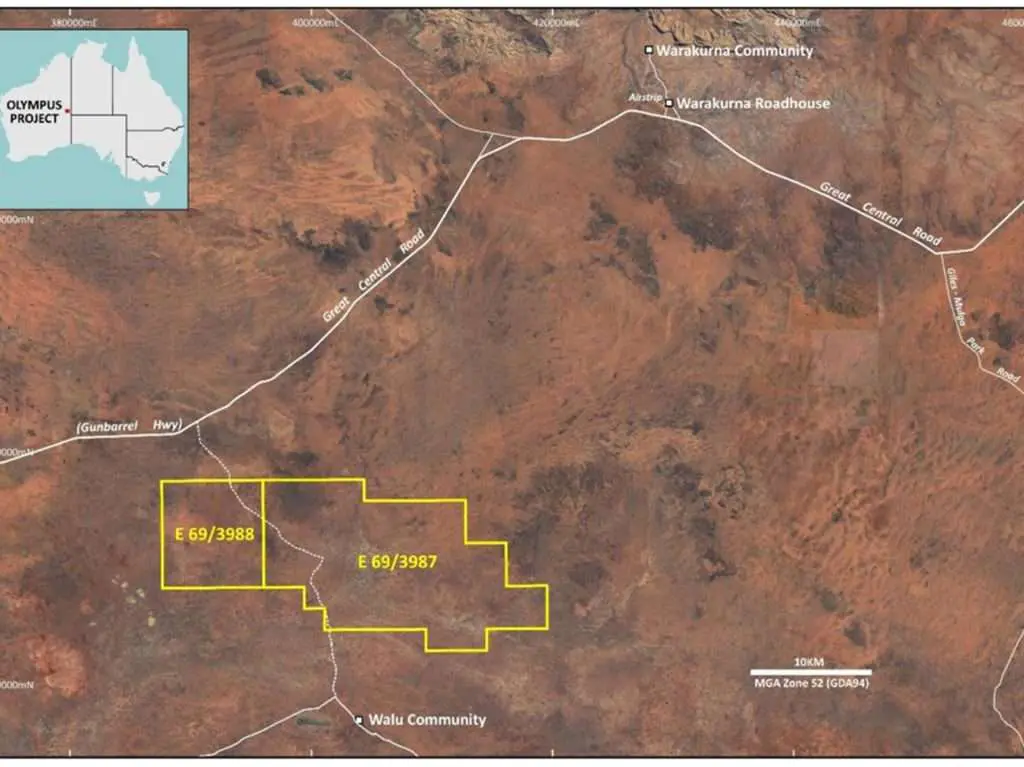
The earlier stage Olympus Scandium Project located in the West Musgrave region of Western Australia is owned by Hawk Resources Limited (ASX: HWK). Hawk believes that Olympus represents an opportunity to discover a new scandium district following a review of exploration results from work completed 20 years ago. Critically the historical exploration was for copper, nickel, platinum group metals and cobalt – scandium was not a sought-after commodity at the time.
The review of past exploration identified a 7km x 4km soil anomaly grading +500ppm Sc with individual soil samples grading up to 1,200ppm Sc. The past work also included 24 shallow RAB drill holes spaced at 200m intervals along 4 traverse lines which intersected high grades of scandium from surface including 11m @ 934ppm Sc, 5m @ 948ppm Sc and 6m @ 821ppm Sc. All of the RAB holes intersected anomalous scandium over minimum thicknesses of 2m with grades exceeding 300ppm Sc. Individual 1m sample intervals down the holes assay up to 2,037ppm Sc.
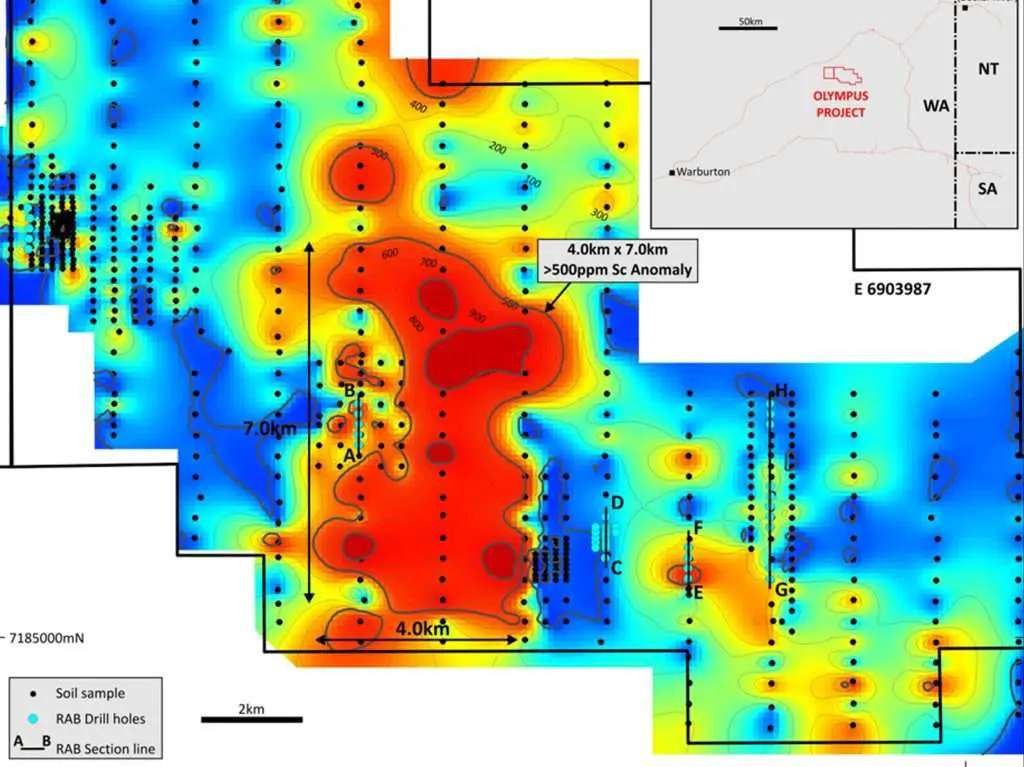
Importantly none of the RAB holes were drilled within the soil anomaly although two lines traversed separate scandium soil anomalous zones. All the scandium assays were taken using a portable XRF analyser and the RAB results support the earlier soils.
After picking up the project in October 2025, Hawk announced an Agreement for Mineral Exploration with the Ngaanyatjarra Traditional Owners in May which marks a major milestone on the path to commencing exploration. Following completion of a cultural heritage survey on the ground and ministerial consents, work on the ground is expected to commence in June 2026 with the first phase being soil sampling and lab assaying to confirm the historical results. If this proves successful, exploration to delineate the highest priority zones for drilling will follow.