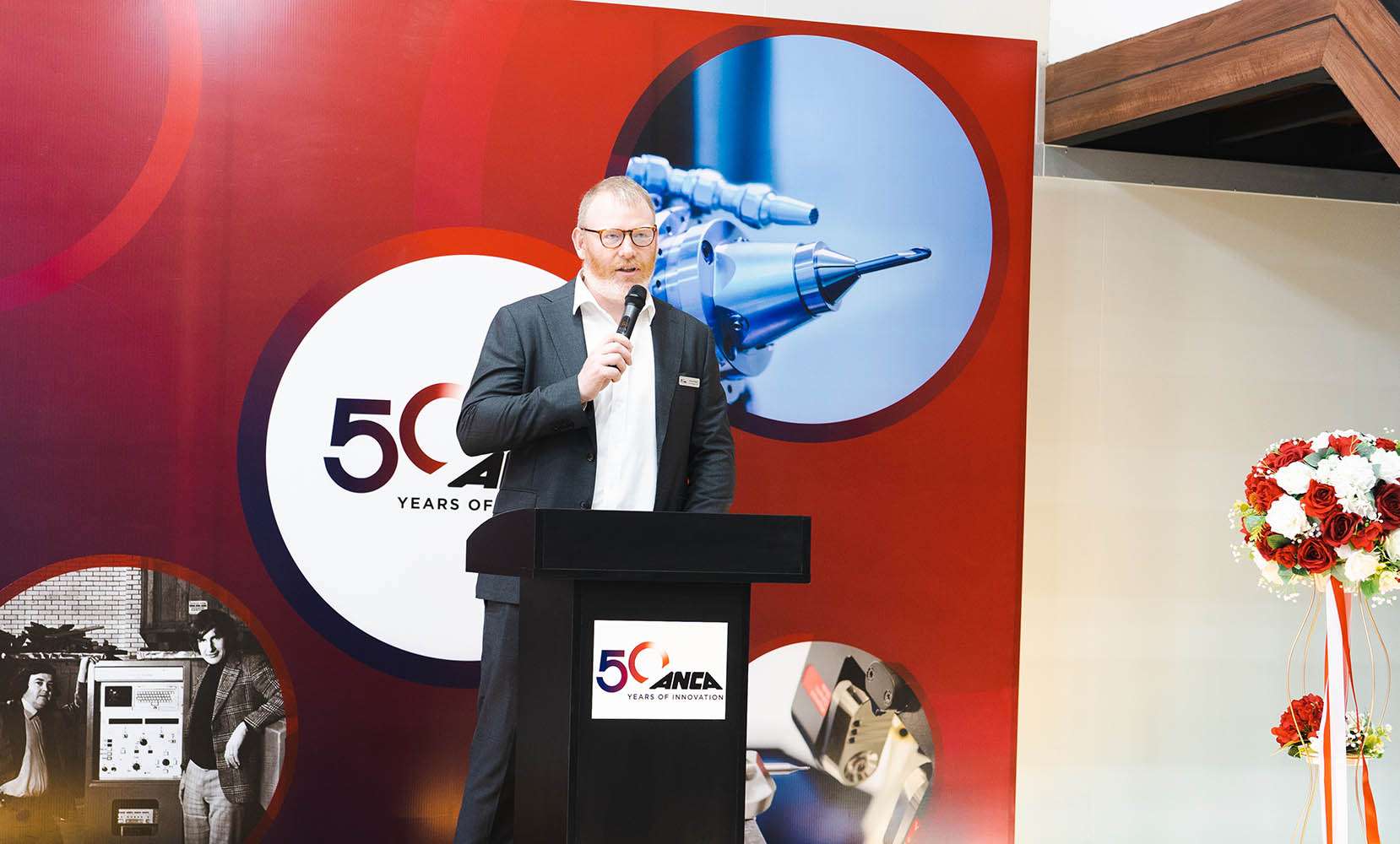
As ANCA celebrates 50 years of advancing tool manufacturing technology, Edmund Boland, General Manager of ANCA CNC Machines, looks ahead five to ten years
Just a person and a dog?
The old story about the factory of the future being populated by one human and a dog—the human’s role is limited to feeding the dog, while the dog is charged with keeping the person away from the machinery—will be close to reality for tool grinding.
At a minimum, said Boland, the entire production process will be linked digitally, “from the intake of the raw material to palletising, laser etching, and blank preparation…to the tool and cutter grinding, edge prep, coating, and right through to shipping the finished goods.” For example, when a particular job transitions from OD prep to the 5-axis grinders, the machines will automatically call up the correct program to finish grinding the tools. Everything will also be linked to a company’s ERP and MES system, providing “very good data analytics to help make the right decisions and improve your processes.”
Individual processes, such as OD grinding or stream finishing, are often highly automated once they’re set up. So, what will differ among thriving companies, as Boland sees it, is the degree to which those processes have been automated and the degree to which the transfer of material between stations has also been automated.
“A small to medium shop will probably have a person who’s physically moving and scanning, let’s say, a pallet from the OD machine to the five-axis machine. But digitally, the five-axis machine receives a file that says it’s getting these blanks, and it’s all tied in with the ERP system. The same thing would happen if they’re subcontracting the coating. Digitally, they’re sending that information to the coater, but somebody is manually moving tools from the five-axis to the shipping department. In a large shop, a robotised cart would make the physical moves.” That’s the case with ANCA’s Integrated Manufacturing Systems (AIMS).
Improving setups and quality
Boland says the more automation a shop achieves, the more consistent its output quality and the more its workers can concentrate on solving isolated problems and improving the entire process, aided by AI. “Invariably, there will be tools that are out of tolerance. And someone will need to ask, ‘Why? What do we need to tweak? Is there an issue with one of the production steps? Is the program wrong?’”
Competitive companies will rely on relatively few highly skilled problem solvers. These people will, in turn, rely on the advanced training available at the ANCA Academy.
Boland also envisions a continuing role for skilled people to set up machines, though changes are also coming. “For example, technology like steady rests will have sensors and the ability to make automatic adjustments.”
“Automatic compensation to correct errors detected in-process is already a reality, and this capability will only improve,” Boland adds. For example, with today’s technology, if the machine loads a blank askew, the probe detects the error, and the grinding problem automatically adjusts to produce a satisfactory tool. But, “you still need to manually check the first piece, especially if it’s a new type of tool. After that, the system can take over. ‘First tool right’ is already our big mantra. You should be able to measure the first tool, and if wrong, be able to compensate.”
One contributing factor is the ever-increasing capability of internal measurement devices. Boland observes that their new generation lasers can measure in coolant mist and even some residual oil on the tool itself. Vision systems still require manual placement and removal after use, but “that will change. Camera systems require better ventilation than lasers, but there are solutions. A robot can blow out the debris from the environment within the machine right after grinding. Or you could use a robot to bring the camera into the machine from an external location.”
At the same time, the list of features that can be measured internally and automatically compensated will grow. Today, it’s “things like OD, tool profile, and flute depth. In a short time, we’ll be able to do more. The threads within a thread mill or a tap, for example. A K-land. Or the gash. It can be compensated as long as measured within the system.”
Boland doesn’t think we’ll eliminate the need for stand-alone measuring machines like the ZOLLER Genius, especially when measuring complex features. But he foresees improvements in the interplay between such systems and tool grinders.
The key, he explains, is the establishment of standardised measurement protocols for specific geometric features. “Until these measurement protocols are created, no tool grinder can compensate for a measured deviation. Currently, ANCA has a standard set of measurements available for simpler end mills and drills. But as we install AIMS throughout our customer base, we’re also working with these customers to expand the range of measurements we can compensate. We’re getting into quite complex profile tools, and complex end mills, for example.”
Sub-micron tolerances
It’s no secret that tolerances are getting tighter. Boland says achieving micron, and even sub-micron, levels of precision will be the key to capturing many future applications. Demand for such accuracy “will grow because of the benefits of these cutting tools, whether it’s the surface finish of the workpiece that’s being machined, tool life, or other factors. Removing all the small inaccuracies within the cutting tool lifts its performance significantly.”
This is also why the market is moving toward solid round tools versus indexable cutters. “Customers want the rigidity of a solid round tool and the advantages of pushing the tool while achieving an excellent surface finish,” reports Boland.
Maintaining higher levels of precision will take more than the highly functioning automation, in-process measuring, and closed-loop compensation functions covered earlier. “Simple, though expensive, things like air conditioning,” lists Boland. “The coolant systems. The types of wheels you buy… It’s not just the tool and cutter grinder. It’s the whole system around it.
“Eliminating vibration is going to be critical. No longer will you be able to attach a mist extractor directly under the canopy. The air conditioning unit within a machine tool will become very important. Because if it vibrates, it will cause problems.” Thus, a central coolant system and central mist extraction are required.
Although Boland predicts a growing demand for ever more accurate tools, he also thinks there will continue to be demand for lower-cost tools. That, plus the inherent cost and difficulty of meeting the tightest tolerances, will limit the adoption of the discussed improvements.
Material trends
According to Boland, Carbide continues to be the dominant cutting tool material, but PCD use is growing faster. Thus, PCD may reach 30% of the market in 10 years. Ceramics are also getting more interest, but remain a small part.
Likewise, the need for material removal technologies other than grinding will grow. Boland says that wire and rotary EDM are now predominant for PCD, but laser ablation bears watching. “It is definitely an emerging technology. Customers with early machines are using them not only for PCD but also for carbide. In particular, micro tools are now seen as having the potential for laser ablation, and tool makers are getting interesting results.
“In terms of PCD, laser ablation has its advantages over erosion. It doesn’t require coolant or consumable copper electrodes.” So, though the machines might remain 40-50% more expensive than competing technology, they might save money over time due to lower consumable costs. Laser ablation also can produce shapes that can’t be created with erosion, including surface features. Conversely, it doesn’t make sense for fluting larger diameter tools. Boland remains uncertain of laser ablation’s near-term future being more than a niche solution.
Similarly, additive machining is not likely to replace more than a few material removal applications in the industry. And its applicability to the production of cutting tools appears to be limited. “I don’t see it becoming efficient enough in ten years. But potentially, it has a place in producing special tools, with otherwise impossible internal coolant channels and those kinds of things. It might also have a role in creating big, expensive, cutting tools. But even if it does take off, I don’t believe it will be accurate enough to eliminate the need for finish grinding.”
Other market considerations
Given the production efficiencies Boland envisions, you might expect regrinding to die. But not only will the automation solutions discussed earlier also apply to regrinding, Boland surmises that sustainability concerns will continue to make it a viable business.
At the same time, the greater efficiencies achieved by forward leaning tool producers will create expectations in the market for faster turnaround times, even for small quantities of special tools. Boland said, “the ability to easily produce optimised special tools for a specific job is what will be important to our customers.”
Unsurprisingly, the move to electric vehicles reduces cutting tool demand in the automotive sector by as much as 50%. This varies around the globe, with the US lagging in EV adoption. There are also “growing applications outside of the EV area which might be compensating,” Boland states, though the total impact of EVs will undeniably be large.
“And then there’s the question of where the technology will land. But it’s almost a philosophical discussion rather than a factual one. Will hydrogen take over? Will ultra-clean fuel return and give the combustion engine another lease on life? Who knows?”
Changes to service & support
Boland predicts that AI will “be a huge productivity improvement mechanism for the future,” partly because it contributes to accurate warning of component failures in advance. It can even automatically order the replacement part. Thus, preventative maintenance becomes targeted and efficient while ensuring nearly seamless uptime.
Conversely, Boland points out that multi-machine automation makes any downtime intolerable. “Customers can live without a single machine for a day or two. But if a fully automated system is not up within a few hours, that’s a big problem. So, responding rapidly and around the clock will be important. Different technologies will allow that.” This includes remote and predictive diagnostics “to reduce the necessity of having a service person on site.”
Whatever the future holds, it’s sure to be interesting. And if Boland turns out to be wrong about anything, you can always count on your dog.