



Rolling some history and origins of the K Factor in metal rolling technology with Alessio Maiocco, Area Sales Manager at MG S.r.L.
Let’s delve into the world of the ‘K-factor’. This term, coined by journalist Alberto Ronchey, former Italian minister of cultural and environmental heritage, has an interesting history. It was initially used to describe the lack of change in political forces in the early 1950s of republican Italy. However, in our context, the K-factor represents something entirely different. It symbolises MG’s ability to innovate its offer, specifically the K-model, an innovative plate rolling model for which our company holds the patent. But why a new model?
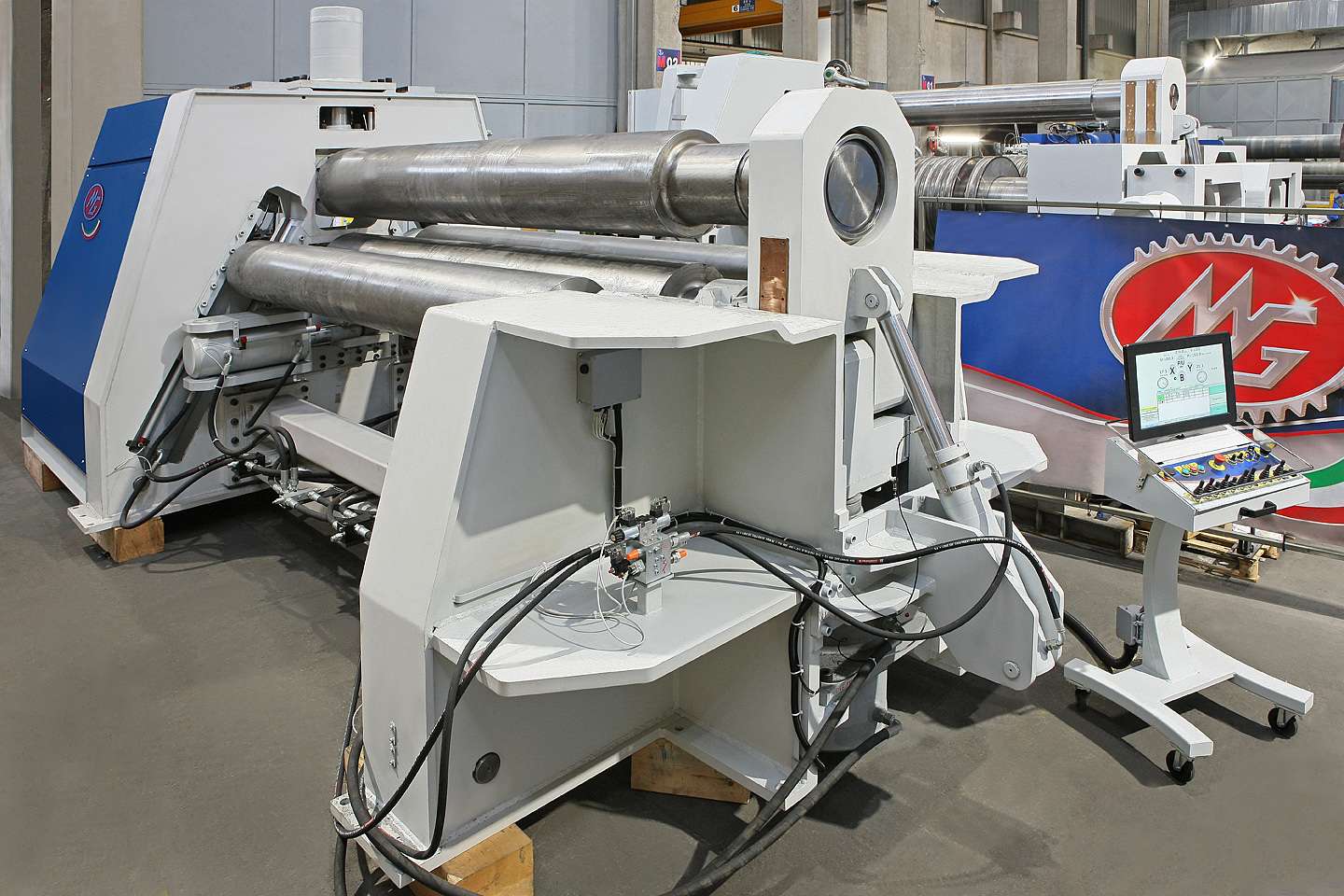
To understand the reason for the K model, we have to refer to a customer who chose two models, namely the 4-roll plate bending machine model K2020C (14mm rolling capacity and 10mm pre-bending capacity) and the 4-roll plate bending machine model K3042G (34mm rolling capacity and 42mm pre-bending capacity). So why choose an innovative model? The answer lies in its configuration: already in the current 4-roller models, the minimum straight side is 1.8 times the thickness of the sheet being processed, which saves a lot of material, but in the K models, the feed side is even smaller, so when processing substantial, thick sheets such as those used for boilers, we try to cut as little material as possible (the aim is to provide a high-quality product while minimising costs and waste). In addition to this first and fundamental technical feature, it is also worth mentioning that the upper roller has an additional vertical movement, thus allowing press bending if necessary. The lower central roller moves horizontally to the right and left, allowing more bending space to be managed: the result is a 4-roller model that can function as a 3-roller model with variable geometry.
All this has been perfected by adding our CNC numerical control, developed thanks to a collaboration with the company DELSY, 75% of which was taken over by MG in June 2012. This numerical control allows us to work in self-learning mode, i.e., the operator enters all the necessary technical data, and the program automatically calculates the shape to be obtained. In addition, this type of numerical control allows the operator to roll complex shapes such as rectangles, tanks, snails, ovals, elliptical shapes and variable radius shapes. The CNC chosen by the customer is version 4.0, meaning that it has the same basic features of the CNC Touch Command EVO with the addition of features like CNC connection by Ethernet cable directly on the electrical panel, Integrated Web App (visible only within the local network) that allows to view the Machine status, order management, executed programs, production charts, maintenance added sensors to check the machine status in real-time (e.g. oil filter or oil temperatures) and the “Industry 4.0” certification.
This result once again demonstrates the company’s ability to keep up with the times in researching and developing new products that meet the needs of all its customers. It should not be forgotten that one of the company’s core businesses is product customisation, so while on the one hand, we continue to offer standard, ready-made products, on the other, we try to study each request, all in the belief that the former Prime Minister of the United Kingdon Sir Winston Churchill said, “To improve is to change; to be perfect is to change often”.