



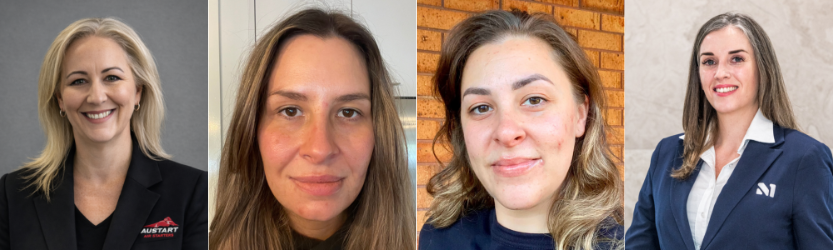
Ahead of International Women’s Day (March 8), four women in manufacturing discuss their experiences and give advice for the next generation.
**This story originally appeared in the February 2026 edition of AMT Magazine**
“It’s really, really interesting seeing how things are made, and what it takes… Now I know and understand much of what was required to assemble things. It’s interesting seeing how things work.” Ten years ago, Melanie Kramer walked away from her retail job at a jeweller in inner-city Melbourne to help her sister Simone and Simone’s partner Brian at Boss Tooling, their year-old CNC machining company in Dandenong South.
She’s still there today – running machines which today include two new Okuma 5-axis CNC mills and helping to refine designs on the factory floor to keep processes running smoothly. Both Melanie and Simone say they did a lot of learning on the job, with Simone initially learning management skills at Brian’s family company Cogley Enterprises before the couple branched out on their own.
“I didn’t have any skills when I started – I got put in an office and didn’t even know what a purchase order was,” Simone says. “But because they are small companies, you learn to do every aspect – and then work ten times more when you’re running your own company. But I like having that control – being a business owner and having that responsibility.”
Like Simone, KH Equipment general manager Narelle Crook also started in the office, “as a receptionist/Girl Friday – back when you were allowed to have Girl Fridays.”
“I had a lot to do with the quality systems – quality auditing, that sort of thing – which gave me early exposure to the shop floor and the systems out there,” she says.
“[It was about] making things more practical. I was spending time on the floor – auditing, but asking questions, getting interested and just working out what the guys needed to make their lives simpler in their day to day.”
Some 30 years later, she is running the place – but she’s still asking questions of the team on the factory floor.
“I have a genuine respect for the trades and operators out there. They’ve often got the solutions to the quality or efficiency issues…You’re never telling them what to do really – it’s more of a collaboration,” she says.
“You’re asking them for feedback, and trying to get their input – because day in, day out, they know what’s required, or what could make things better.”
For Erin Wright, chief financial officer at Maskill – which specialises in undercarriage solutions for heavy mining equipment – a sense of curiosity is important as a leadership quality. “I’m out on the workshop floor every Friday, seeing what machines have landed, what capexes have been completed… I’m very invested in the whole process of how things are made and how things are done,” she says.
Having started her career in financial services, Wright later worked on logistics and complex supply chains in defence industry roles before the opportunity came up to bring her experience in governance to manufacturing.
“With the increased focus on governance and ethics in mining manufacturing, that’s where I thought I could bring a lot of value to a company in that industry,” she says. Moving to Maskill was part of a career plan to diversify her skills set and to plan for her career going forward.
“I stayed in financial services for a very long time because I was at the top of my game in those roles, and I was a single parent,” she says. “Once you’re very good at your job, you get a lot of flexibility – but I always studied the whole way through… I’m still studying, I’m doing my MBA now.”
“If you want to get somewhere you have to put the work in, and the work happens outside of your actual job – so where you’re working on yourself, and you’re working on that next role that you want to get,” she says.
The next big thing
When it comes to a general discussion of women in manufacturing roles, Wright describes what she sees as a “two-speed economy” – where there are more women in leadership or administrative roles, but far fewer on the factory floor.
“Heavy plant manufacturing is physically demanding. In a tight labour market it doesn’t always stack up with your recruitment strategy because traditionally female roles have, perhaps, a better working environment,” she says.
Among the changes that Maskill has introduced are removing physical impediments through the installation of plate lifters and other equipment, as well as fixed child-friendly rosters and leadership training and apprenticeships.
“It’s really important to us that whatever initiatives come about… benefit the male workforce as well, so we’re not inadvertently fostering resentment,” she says.
“I think perhaps in more automated, advanced manufacturing there might be differences… we’ve made efforts to make it more attractive to women, but in a tight labour market, I just don’t think that women want the job.”
At KH Equipment, where Narelle Crook says the workshop environment has changed significantly over time, one solution to that problem is improving career education for young people.
“It’s hard enough getting the male students exposed to the trade as a career, let alone females, and it’s changed so much that they would have no idea the sorts of things that these tradespeople can do… the technology, the software systems – they can do amazing things,” she says. “It’s still not normal to see females out on the shop floor for those places that I have been at, but as a general rule … it’s all very respectful – but it’s a mutual respect, I think.”
“Occasionally you come across some that will explain things with a bit of condescension, but they’re usually that way with everyone – they’re not very good at explaining without talking down to people in general. It’s not a gender thing.”
At Boss Tooling, Simone and Melanie joke that they do outnumber Brian – “and he knows it!” but see that it is not the first assumption that visitors usually make.
“We do notice if someone, male or female, comes in… they will automatically assume Brian’s the leader and Brian’s the one to talk to,” Simone says.
“I probably do it too – it’s just a reflex, it’s ingrained in us at a young age… and in saying that, it’s only first impressions. Once they know who we are, they treat us equally to Brian, understand what our understanding and capabilities are and respect that.”
Melanie also sees this as a reflex. “We don’t combat it with aggression or defensiveness. We just redirect: ‘The boss isn’t in at the moment, but I can help you.’ And most of the time, I can,” she says.
Working on the shop floor means that Melanie also encounters some “shop talk” that brings off-colour jokes and old-school attitudes to the surface. “I can give it back just as easily… but it’s a survival thing. We have to do it if we want to thrive in our roles and in this industry, we can’t just sit there and complain, because the reflex will be ‘she’s whinging’,” she says.
“We kind of have to rise above that… assert our authority and say, ‘Hey, not okay,’ or roast them a little bit,” Melanie says.
“Or [say] ‘Get out’,” Simone adds. “It’s a really interesting situation that we’re in, because we have a power that a lot of other women would not have had, and we have had it from the beginning.”
A force for good
Wright says she has found it important to be able to match her leadership style with the needs of her workforce – allowing autonomy to some and providing structure for others.
“I’ve always found the most effective leaders are kind of naturally curious… they don’t necessarily go straight into behaviour correction, but they ask why? What is happening that is creating this, and how do we go about solving it?”
“I think leaning into your strengths and working on the areas you’re not strong in – being able to have that introspection will get you very far as a leader,” she says.
That introspection is also important for the type of work that one does, Wright adds, saying it’s important to avoid wasting time in roles with workplace ethics and cultures that do not align with your own.
“I think a lot of people get stuck working in places that they don’t fit culturally – and they’re wasting all this energy when they could be using their powers for good in another company, or a role that fits better,” she says.
Narelle Crook says she’s seen a real change in attitudes about what women can do in the workplace over the course of her career – adding that this attitude change is helping open the doors for a new generation of women to consider manufacturing.
“If they’re considering it, it’s probably because they like problem solving and working in a challenging environment.
So I would say: go for it,” she says. “Manufacturing is pretty broad—you can be involved in all sorts of areas. There’s lots to learn, and more and more people are getting involved.”
As KH Equipment pursues its ambitious scaling goals, she sees both challenge and opportunity—for herself, her team, and whoever follows.
“There’s always another hurdle to jump,” she says. “But it keeps it interesting. There’s never a dull moment.”
Asked what they’d say to young women considering manufacturing, both Simone and Melanie come back to passion and self-belief.
“If you’re passionate about what you’re doing, you’ll do well – and don’t let anyone make you think otherwise,” Simone says.
“Being female can mean you start a bit behind the line — but you’re also more noticeable because you’re part of the minority.” Melanie echoes her sister.
“Don’t assume you’ll be unsafe or incapable just because it’s male dominated. You’re just as capable as any guy, as long as you’ve got a passion for it,” she says. “It’s tough work, but it’s not too tough for you.”