



July 25, 2019
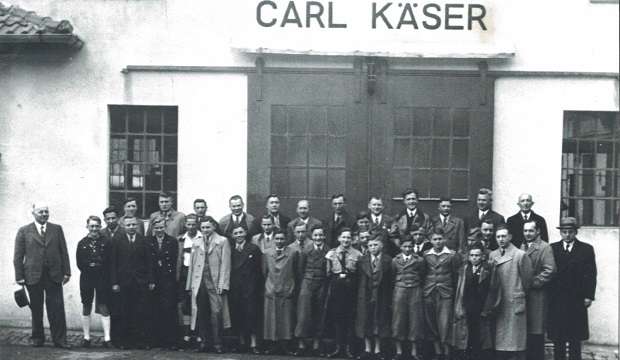
The history of the German compressed air specialist Kaeser Kompressoren truly is a remarkable story. Although many a company gets to celebrate its centenary, they cannot all boast such sustained and continuously positive development. While the Kaeser product range can be found in action all over the world, the general public rarely come face to face with the compressed air specialist’s products. Only the portable compressors catch the eye, with their black and yellow livery, when used for road construction work. Compressed air stations tend to be hidden away in outbuildings. Nonetheless, Kaeser compressors are just as likely to be found in power stations in Australia as in Peruvian gold mines, used by aerospace engineers in the US, fish farms in Norway, car manufacturers in Germany, at the CERN particle accelerator in Switzerland, on ski pistes in Austria, on Arabian oil fields or the weaving mills in Asia. Often considered the fourth utility, compressed air…
July 25, 2019
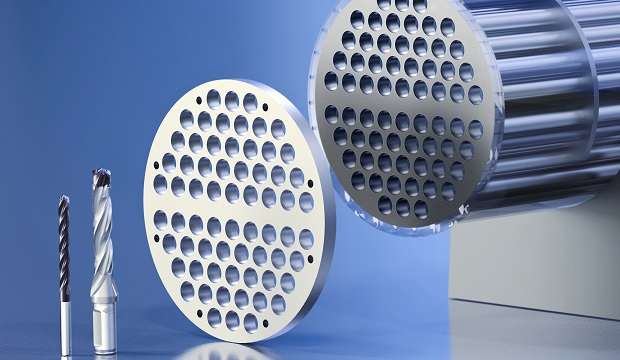
Many types of heat exchangers are used in industry. In the case of recuperators, two liquid or gaseous media with different temperatures are pumped into separate circuits. A heat exchange takes place without mixing the media. Recuperators include bundle heat exchangers, which are usually made of metal and consist of a tube bundle that conducts a medium, and an orifice baffle with a front tube plate through which a second medium flows. Depending on the size of the heat exchanger, the front tube plate has a large number of bores. To ensure that the medium does not escape at this component transition, high requirements are set at the bores with regard to position accuracy and dimensional accuracy. The triple-edge replaceable head drill TTD-Tritan from Mapal has been tested in the petrochemical industry and produced convincing results when machining a tube plate. On the TTD-Tritan, the tool head and tool holder are joined by Hirth serration. This connection is easy…

July 25, 2019
Intellectual property is a broad term that covers a range of intangible assets resulting from creations of the mind, such as inventions, literary works or videos. In a business context, IP arises from the creativity of employees and/or owners, such as text and images on websites, manuals and other documents, inventive processes, products or brand names – just to name a few. IP can be registrable and non-registrable, and both types have their uses and their place in managing a business. Examples of non-registrable IP may include copyright, circuit layout rights, trade secrets and confidential information, while registrable IP encompasses patents, registered designs, trade marks and plant breeder’s rights. The following list provides a brief description of the main IP types: Patents are registrable rights that protect the functionality of a product or process, i.e. the way it works, such as the working of an…
July 25, 2019
An enterprise resource planning (ERP) system is an integral part of operations, but your requirements of this system would be different whether you are operating a tin can factory in Toronto or manufacturing stereo equipment in Sydney. This means that a one-size-fits-all approach won’t take into consideration the industry nuances at play, nor embrace the individuality of your business that ultimately enables your competitive edge. The reality is the choices you make right now will affect your competitive advantage and your ability to remain relevant in a rapidly changing business environment. The aspect of choice should be extended to the selection of elements that make-up the solution whilst also addressing your immediate business priorities as well as offer the potential to extend…

July 17, 2019
RAM3D is a metal 3D printing facility and high-tech manufacturing company producing parts for a diverse array of industries world-wide. The technology has greatly advanced over the past five years and RAM3D has seen a shift from prototyping to include full production work. This is possibly a result of the early adopters of the technology starting to move their projects increasingly through the project stage. The two key drivers to this transition are: Designers have recognised that the technology opens different design avenues. They can look at the areas of function and load and only place material where it is needed. This design freedom results in a highly optimised part in both functionality and cost. The cost of production by 3D printing has reduced. RAM3D operates four machines; they have been able to cover their overheads and apply the lessons they have learned over time to refine the process and ultimately bring benefits to companies having parts made. Throughout most of the world, two of the early…

July 17, 2019
Established in 1962, the Opie Manufacturing Group – an Australian fabricated metal manufacturer, offering a wide range of products and services – has been part of that transformation, and is fully embracing the Internet of Things. Covering over 7,000sqm under roof, Opie Group’s expansive state-of-the-art manufacturing and metal processing facility in Emu Plains, NSW, is one of the largest in the industry. ((subhead)) The problem Prior to November 2018, Opie Group’s machines were operating independently not only of each other, necessitating manual intervention in the production process, but also of the customer care process, leading to a lack of visibility when it came to understanding what stage of the production process a project was at. “Previously, we had no data available to determine where our inefficiencies were throughout the production process and where…

July 17, 2019
Manufacturers seeking to overcome these challenges must study all elements of their machining systems and apply techniques and tools that assure success. Among the key elements are machine stability, tool-holding, workpiece clamping and cutting tool geometry. In general, solid fixturing, rigid tooling and careful tool application make up the basic foundation for accurate, productive boring and long-reach turning processes. Producers of oil & gas, power generation and aerospace components are prime candidates for updated tooling and techniques because they regularly deal with large, complex parts with features that require the use of extended-length tools. Many parts are made from tough alloys that are difficult to machine and thereby produce high, vibration-generating cutting forces. In general, nearly any manufacturer can benefit from improving productivity…

July 17, 2019
AMT: What are the different tap designs? Johan Bodin: There are several tap designs, of which the most commonly used is the straight flute. This design is suitable for blind or though-hole thread production in most materials, especially steel and cast iron. Spiral point taps are recommended for threading through holes as they feature a straight, shallow flute with a point designed to drive the swarf forward. Finally, spiral flute taps transport swarf back out of the hole, away from the workpiece material, and therefore are primarily used for threading blind holes. A less common but still important part of our threading program are fluteless taps and thread milling cutters. AMT: What…
July 17, 2019
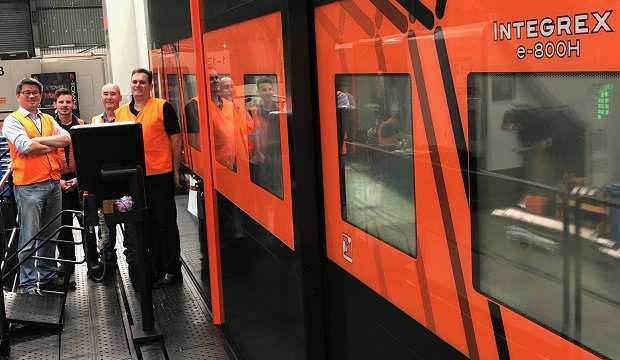
Established in 1964, ABON joined the FLSmidth Group in 1998 to provide products and services used in mining operations. The main products that the company manufactures include high-tonnage and high-availability twin roll sizers, rollerscreens and chain feeders. These machines crush, screen and feed ores according to size required prior to being transported into the process plant. FLSmidth ABON’S product lifecycle approach helps customers to reduce emissions, lower operating costs, and enhance productivity based on a unique combination of key products, process expertise and service solutions. With countless technological innovations in engineering, the company has been a leading pioneer in the minerals-handling and minerals-processing industries for more than 50 years. FLSmidth ABON previously manufactured its shaft components on multiple machines in several set-ups, resulting in long in-process time. After extensive study of the best available tools and machinery from Mazak, working in conjunction with Iscar Australia and Ingersoll Germany, the company has completed development of a unique skiving process that was the first of its kind due to the large module size. Utilising…

July 10, 2019
AMT: What’s the current state of play for the manufacturing industry in South Australia? David Ridgway: South Australia has a very long history of manufacturing, which is transitioning into new, more advanced industries including space, energy and future mobility, and will rely on new materials and processes to be competitive. With more than $50bn in future defence manufacturing happening in South Australia, opportunities for business have never been better Our geographic positioning, topography, climate, long, straight regional roads, world-class manufacturing and technology have positioned the state as a leader for safe autonomous vehicles - it’s worth pointing out that Adelaide is the only city in the world to be currently trialling four brands of autonomous shuttles in public areas. Adelaide has been chosen by EasyMile as the location for its Asia-Pacific headquarters, which is being established this month, and manufacturing will commence in partnership with South Australian businesses later this year. AMT: What are the biggest…

July 10, 2019
There are many machinability issues with stainless steel (ISO M) and HRSA and titanium (ISO S) materials. With regard to ISO M materials, machinability often decreases with a higher alloy content. And while chip control is fair in ferritic/martensitic materials, it becomes more complex in austenitic and duplex types. Perhaps most troublesome of all is that machining these materials creates high cutting forces in combination with built-up edge and work-hardened surfaces. The combination of these factors serves to compromise tool life. In terms of ISO S materials, the physical properties and machining behaviour of each varies considerably, due…

July 10, 2019
Released in May by AMSI and CSIRO Data61’s student-employer matching platform, Ribit.net, ‘Advancing Australia’s Knowledge Economy – Who are the top PhD employers?’ shows over half of PhD students are hoping to work in industry. One of the biggest factors in this shift is the lack of university-based positions. PhD graduate numbers are overtaking academic demand, with annual completions soaring from under 4000 annually in the year 2000 to almost 10,000 today. This trend has seen some of Australia’s largest business employers emerge as leading PhD recruiters. Aligned with the nation’s growth sectors, medicine, pharmaceuticals, mining and finance join advanced manufacturing as top employers. There is also growing demand across emerging industries such as environmental services and media technology and services. This is good news for big business and SMEs looking for quantitative, analytical and research expertise to drive advanced and digital manufacturing innovation. The scope of roles for PhDs continues to broaden, with global competition driving many…

July 10, 2019
When we think of robots, we often think of either clunky metal frames that complete menial tasks, or something so human it is almost indistinguishable to the person standing next to you. Both appearances have their uses though, whether it’s for picking, packing and palletising in a manufacturing plant, or entertaining guests at an amusement park. Traditionally, robots have been large and noisy pieces of equipment, often posing potential safety risks to the workforce. A new breed of collaborative robots has changed this though, allowing machines to work side-by-side with human employees. This type of robot is now becoming increasingly commonplace on the plant floor, revolutionising the…